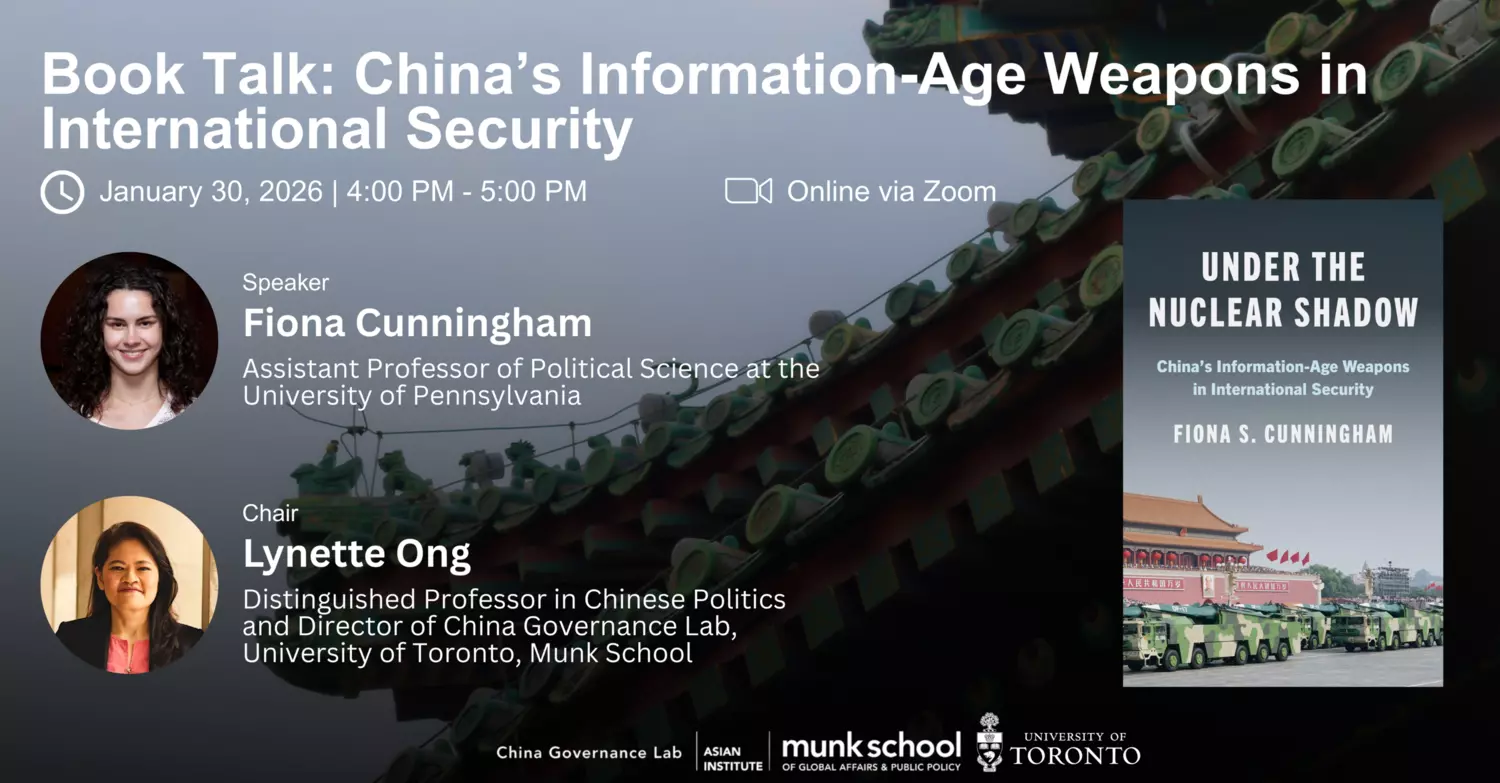
On January 30, 2026, the Asian Institute at the Munk School of Global Affairs and Public Policy held an online book talk titled “Under the Nuclear Shadow: China’s Information-Age Weapons in International Security,” which featured a recent publication by Dr. Fiona Cunningham, Assistant Professor of Political Science at the University of Pennsylvania. The event was chaired by Lynette Ong, Professor of Chinese Politics and Director of the China Governance Lab, with commentary from Assistant Professor Dani Nedal, jointly appointed at the Department of Political Science and the Munk School. The presentation examined China’s distinctive approach to deterrence and coercion in the post-Cold War era and explored how China has sought to pursue its political and military objectives while avoiding any nuclear conflict.
The main question highlighted in the event was: how can states use military force to achieve political agendas without triggering nuclear war? Although this dilemma applies broadly to nuclear-armed states, Professor Cunningham argued that China has responded to it in a uniquely consistent and systematic way. Rather than relying primarily on nuclear threats or overwhelming conventional military victories, China has mainly turned to what Cunningham called “information-age weapons.” These include offensive cyber operations, counterspace capabilities, and precision conventional missiles, all of which are intended to provide coercive leverage while escaping any nuclear escalation. The book talk presentation gave an in-depth explanation of this strategic logic and its implications for international security.
Professor Ong started the event by introducing the speakers and speaking about the broader debates on global security and China’s role in the international system. She highlighted Cunningham’s academic background and research focus on the intersection of technology and international security, particularly with an empirical emphasis on China. Professor Ong also emphasized the relevance of the book to contemporary security challenges, especially as technological advancements continue to reshape the character of warfare and deterrence.
Following this introduction, Professor Cunningham began her presentation by outlining the core argument in her book. She explained that China faces a persistent strategic dilemma: how to coerce powerful adversaries, particularly the United States, without provoking a nuclear response that would be disastrous for all sides involved. Historically, nuclear-armed states have relied on either explicit nuclear threats or strong conventional forces capable of delivering decisive victories. China, however, has taken a different path. China has instead invested heavily in information-age weapons as substitutes for nuclear threats, developing a strategy Cunningham called “strategic substitution.”
According to Cunningham, this strategy came from specific historical experiences. In moments of crisis with the United States, China’s leadership saw the limitations of its existing military capabilities. These crises exposed gaps in China’s ability to credibly deter or coerce its adversaries under the shadow of nuclear war. Rather than attempting to match the United States in nuclear or conventional military power, China took a different approach. It relied on information-age weapons, as they were promising due to their ability to disrupt adversaries’ military operations and strategic assets without causing nuclear war.
Cunningham states that these weapons are not only tactical tools, but they are also useful in broader strategic logic. For example, offensive cyber operations can target an adversary’s command, control and information systems, possibly lowering their ability to respond effectively in a crisis. Counterspace capabilities threaten satellites that are crucial for modern military operations, such as navigation, intelligence, and communication. Precision conventional missiles provide China the capability for accurate strikes, creating coercive pressure without the destruction that comes with nuclear weapons. All together, these capabilities are a toolkit created to influence adversaries’ behaviour while managing escalation risks.
An important contribution of Professor Cunningham’s work mentioned in the event is her theoretical framework for understanding why China adopted this approach. Strategic substitution, as she defines it, occurs when states seek alternative military capabilities to compensate for weaknesses in existing ones. In China’s case, information-age weapons became substitutes for nuclear threats because they allow China to accomplish a form of deterrence and coercion that was fitting within China’s constraints and political objectives. Cunningham agreed that this framework helps explain not only China’s military investments but also its broader approach to crisis management and deterrence.
The presentation also addressed how China’s strategy compares to the strategies of other states. While other countries have developed cyber and space capabilities, China stands out because it has developed these tools to play a central role in its deterrence strategy. Whereas some states still prioritize nuclear signalling or conventional dominance, China has integrated information-age weapons into its strategic thinking as a primary tool of coercion. This distinction has important implications for how other states should interpret China’s military behaviour and strategic intentions.
After Professor Cunningham’s presentation, Professor Nedal commented as one of the event’s speakers. Professor Nedal’s research focuses on global security and international order. He highlighted the value of the book in connecting theoretical and empirical analysis and how her work gives a clear explanation for patterns in China’s military development.
Throughout the discussion, the role of the United States was extremely relevant. Cunningham’s analysis made it clear that many of China’s strategic choices are shaped by its interactions with the United States. The inadequacy of China’s earlier military capabilities became apparent in periods of crisis, motivating China to find alternatives that could provide credible leverage.
Professor Ong concluded the event by holding a Q&A and reflecting on the significance of the book for scholars and policymakers. She emphasized that the book contributes not only to the study of Chinese security policy but also to broader debates on international security in an era of increasing technological change. The book’s focus on strategic substitution gives useful insight for analyzing how states navigate the constraints created by nuclear weapons while looking to maintain influence and protect their interests.
Overall, the book talk was very insightful and analytical of China’s approach to deterrence and coercion. Professor Cunningham’s presentation challenged simplified approaches that portrayed China’s military development as either purely defensive or destabilizing. By focusing on information-age weapons as substitutes for nuclear threats, Under the Nuclear Shadow gives an understanding of how China seeks to manage escalation. Thereby, the book talk was a valuable contribution to the ongoing conversations about warfare, deterrence, and international security.