Abstract
This policy briefly analyzes Gender-based Digital Transnational Repression (G-DTR) and the best policy implementation to protect Burmese female activists from Myanmar’s current authoritarian military coup. After examination of existing literature surrounding transnational repression and its global implications, three policy briefs have been proposed including Option A for the establishment of a Refugee Protection Asylum Status Program under the United Nations High Commission for Refugees (UNHCR), Option B for The Association of Southeast Asia (ASEAN) to create interregional Anti-Doxxing Laws within the region, and lastly Option C, which proposes the region work with NGOs toward digital cybersecurity training and create an encrypted cyber network hotline for all Myanmar women undergoing G-DTR threats. Option A was deemed the most realistic and feasible long-term solution for Myanmar female activists. Option B and C were rejected due to limitations arising from geopolitical tensions with China and concerns over political feasibility of anti-doxing laws which could inherently breach member states safety and security laws.
Keywords: Burmese women, Gender-based Digital Transnational Repression, Cybersecurity, Doxxing
Executive Summary
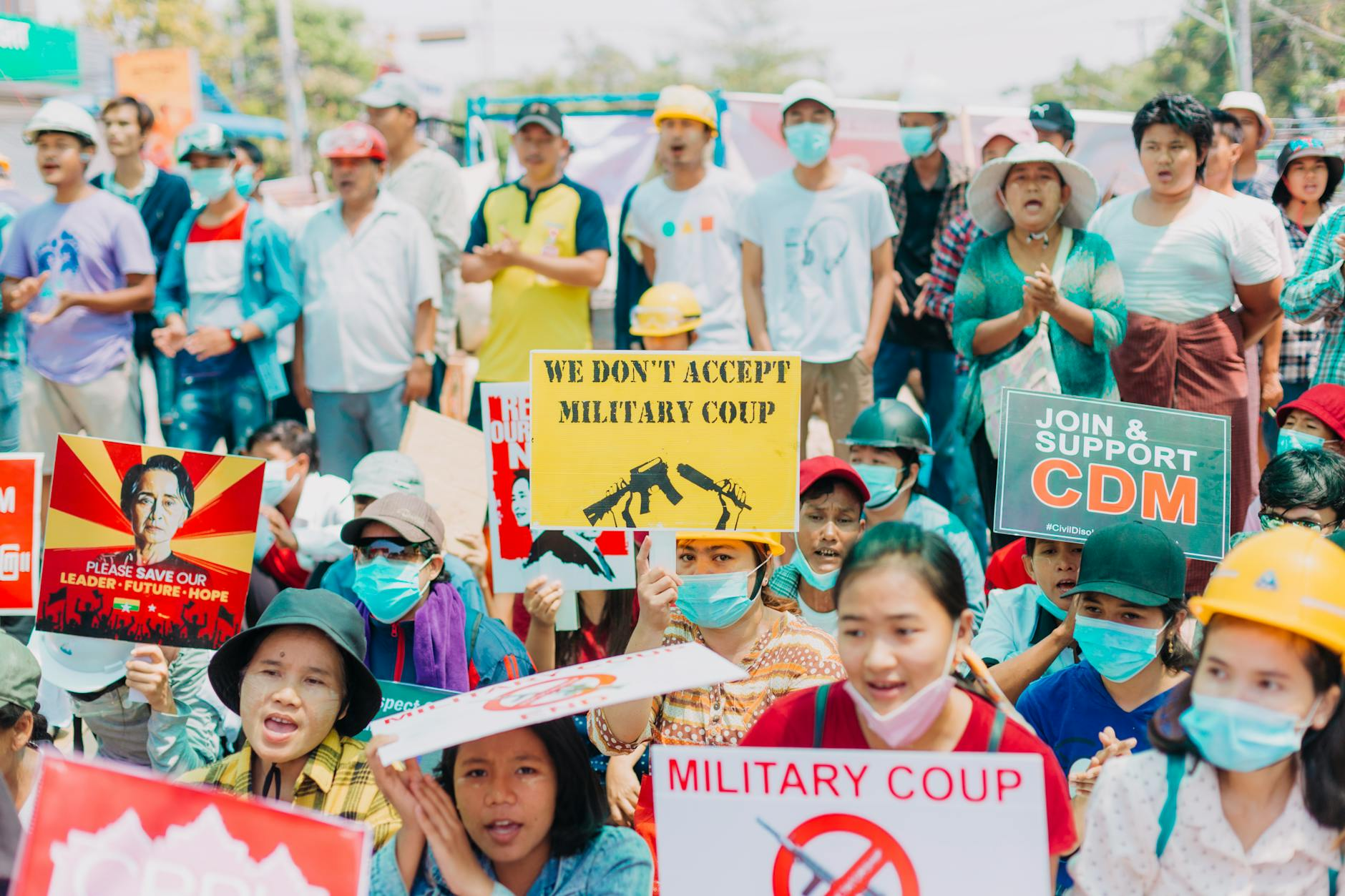
Since the 2019 military coup, Myanmar’s digital sector has transformed from a sovereign civil space for political participation into a highly-regulated space controlled by authoritarian dictatorship that has weaponized online platforms to dismantle civil and political engagement. In Myanmar today, the junta, which is the governing military body that overtook the elected leader, uses surveillance technologies such as pegasus spyware and internet blackouts to silence voices, disproportionately targeting Burmese female activists through the government’s Cybersecurity Law which routinely “doxx” women activists and journalists, releasing personal information alongside sexualized disinformation and threats of arrest, rape, or death[1]. It is in this light that we see Gender-based Digital Transnational Repression (G-DTR)[2] being systematically implemented to suppress the voices of Burmese women, exploiting their right to expression, privacy and safety through government control of the digital sphere[3].
In Myanmar, the active political participation of diaspora women places them at a higher risk for online degradation in the form of state surveillance, smear campaigns resulting in online sexual harassment and doxxing, which eventually encourages womens’ self-censorship[4]. This also highlights how silence among women on digital platforms in Myanmar is not by choice, but rather, the sheer result of a structurally-reinforced phenomenon of actively restricting women’s political participation. G-DTR is connected to authoritarian practices, as the media created a digital sphere that reinforces pattern of victim blaming that results in fewer Burmese women seeking judicial justice due to societal isolation[5].
The implementation of G-DTR in Myanmar not only demonstrates the active threat of digital censorship to Burmese women, but also speaks to a deeper issue of the weaponization of digital media to degrade women by means of smear campaigns and gendered harassment[6]. This raises the question of what policies or incentives will be most effective to ensure the safety of Burmese female activists from the junta’s existing acts of G-DTR.
To improve protections for the safety of female activists in Myanmar, the UNHCR and female activists in Myanmar should consider the following proposed policies including (1) UNHCR’s Refugee Protection Asylum Program in Southeast Asian countries, (2) Establishing Anti-Doxxing Laws across Southeast Asia and (3) Digital Cybersecurity training and encrypted cyber network hotline for all Myanmar women [7] . By incorporating education, anti-doxxing and asylum protection frameworks in multiple Southeast Asian countries, it offers a feasible long-term network to protect G-DTR females across borders. This policy brief will analyze the three proposed solutions and provide policy recommendations for UNHCR, ASEAN and Burmese Female Activists to implement against Myanmar’s digital dictatorship.
Issue Background
To better get a sense of how G-DTR silences Burmese activists, it’s important to analyze how it is practiced around the world from existing literature. Siena Anstis and Émilie LaFlèche from the Citizen Lab[8], an interdisciplinary research unit at the Munk School of Global Affairs & Public Policy at the University of Toronto, defines the complex relationship between transnational repression and marginalized and diaspora communities by situating digital oppression as a patriarchal tool to conduct misogynist attacks. Through an intersectional perspective they illustrate how transnational repression is especially rooted in gender-based misogyny and discrimination[9]. The authors address how perpetrators exploit sexism to personally attack a woman’s family, body and social status to reduce the credibility of her arguments. These measures are often used to silence female activists by shaming them into self-censorship. Louise Arimatsu[10], a specialist in peace, justice and security for women, demonstrates how digital online platforms reflect the patriarchal social structures visible today and agrees with Anstis and LaFlèche that such practices attempt to silence women’s voices by highlighting structural inequalities in digital technologies.
Similarly, Gorokhovskaia and Vaughan[11] DTR research specialists at Freedom House, discuss the complex relationship between transnational repression and how it targets marginalized and diaspora communities using digital oppression as a tool. Abdual Aziz[12], a researcher specializing in diaspora and cultural mitigation studies, reinforces Gorokhovskaia and Vaughan’s findings by demonstrating how the active political participation of diaspora individuals puts them at a higher risk for state surveillance and online degradation. A similar study conducted by Dana Moss[13], a member of Notre Dame’s Kroc Institute for International Peace Research analyzed how authoritarian countries during the Arab Spring used various measures of surveillance and spyware to track targets across transnational borders who have later become victims of DTR. Gorokhovskaia and Vaughan highlight the examples of Hardeep Singh Nijjar, a sikh activist from India who resided in Canada was killed outside a temple within Canada by the Indian government and how the CBSA used Section 34 of the Immigration and Refugee Protection Act to delay Noura Aljizawi’s, a female political activist from Syria, permanent residence by 3 years as she was investigated for espionage, terrorism and other false accusations. Together, these examples, especially the case of Hardeep Singh demonstrate how transnational repression can threaten the national security of other sovereign countries, making it a transnational issue while also making it incredibly difficult for women to find asylum status when escaping the disproportionate impacts of G-DTR.
The literature regarding the global implications of DTR overwhelmingly highlights the necessity of implementing policies that protect citizens, especially women in Myanmar from undergoing further scrutiny.
Policy Options
Building upon the overarching needs posed by scholars on DTR, there exist three policy proposals for the UNHCR and Myanmar activists that pose themselves as are the most feasible and reliable solutions to protect Burmese female activists today.
Option 1: UNHCR Refugee Protection Asylum Status
From a social and political intersectional perspective, the direct intervention of the United Nations High Commission for Refugees to implement region-wide immediate asylum status for women undergoing G-DTR in Myanmar is seen as the most realistic option. This policy is to support and protect Burmese female activists who are fleeing the country with safety and security in a neighbouring foreign country. Similar to the situation faced by Noura Aljizawi[14], whose permanent residence was delayed by 3 years under Section 34 of the Immigration and Refugee Protection Act because of her previous journalistic work in her home country that resulted in her being suspected of espionage and terrorism, many G-DTR victims attempting to flee their country undergo long visa processes and extreme scrutiny under current immigration policies. Aljizawi’s scenario reflects a similar reality for many Burmese female activities who feel unsafe in their country but are unable to receive immediate asylum protection.
The new proposed UNHCR Refugee Protection Asylum Status Program in Southeast Asia should include an alternative immigration process where various Southeast Asian countries adopt an international measure to categorize G-DTR risk scales and implement strategies for immediate refugee status protection. Without diverting too far from the existing system, this option would improve immigration customs for vulnerable groups seeking asylum status within the region using a correlated interregional approach.
Under Option A, the UNHCR does not need to develop a completely new systematic immigration customs policy but rather implement an interregional process that identifies G-DTR risk and provides immediate asylum. The current immigration policies vary from country to country, creating an unstable and unreliable system for victims in immediate danger, so through an interregional approach suggested in Option A, we can eliminate this barrier and further strengthen G-DTR protection. The drawbacks of an interregional policy lies in the political feasibility of implementing strategic immigration policies for victims without compromising individual sovereign nations security outlines, however with the assistance of the Association of Southeast Asian Nations (ASEAN), Option A can be feasibly implemented across the region.
Option B: Establishing Anti-Doxxing Laws across Southeast Asia
This policy option seeks to establish or revise Southeast Asian countries’ anti-doxxing laws that protect activists who reside in a foreign country. Doxxing, which refers to the non-conseual publication of personal data online that’s used for malicious intent has been one of the key identifying factors targeting activists who have fled to other countries. Under the digital footprint, countries who actively conduct G-DTR use non-conseual publicized data to track down victims and coordinate subsequent actions against them despite transnational regulations[15]. The case study of Hardeep Singh Nijjar who was killed in Canada allegedly by the Indian government which brought Canadian-Indian foreign relations to its lowest is a perfect example emphasising the danger of doxxing and its correlation to DTR and international affairs.
By establishing anti-doxxing laws across Southeast Asia through ASEAN, we can prevent the harmful distribution of personal information. This policy option can decrease the retargeting of past G-DTR victims while simultaneously strengthening privacy laws within the region. Currently, there is no unified anti-doxxing policy framework within southeast asia nor has it been explicitly implemented within all member state nations with an expectation of Singapore’s Protection from Harassment Act (POHA). This approach also attempts to take an interregional distribution method to establish standards for individual privacy and collective de-doxxing. Option B does have its limitations including concerns arising from the political feasibility of an interregional policy, similar to that of Option A, but with regionwide cooperation and acknowledgment of G-DTR, it can certainly be feasible.
Option C: Digital Cybersecurity training and encrypted cyber network hotline for all Myanmar women
Lastly, Option C is a two-part solution involving education and outreach for Myanmar women. The first half is incorporating digital cybersecurity training for children in the education system within member states and regulated by ASEAN, to increase awareness about DTR. Increased awareness to identify online cybersecurity threats and understand the digital sphere is extremely important today, especially in Myanmar under the military digital coup. The second half of the proposed policy involves the establishment of an encrypted cyber network hotline (accessible through VPNs) to allow women in Myanmar and internationally to connect and report G-DTR without government surveillance. This allows for a safe network, especially for Burmese female activists who need assistance and urgent contact with NGOs or UNHCR to report active surveillance, doxxing and cyberbullying. Although Option C will help create a safe network, it also has implications that could prevent the establishment of educational reform mainly including ASEAN not having complete monopoly over all cyber networks, including VPNs within the region. For Option C to be feasible, ASEAN would need to establish a committee board which will act as a governing body that would help victims overseas if the government insists on political suppression.
Option C does have limitations considering the current political situation of Myanmar. When addressing the current state of the authoritarian government in Myanmar, it would be really reluctant to establish educational reform, however, with the help of NGOs overseas, we can lobby to influence a shift in the current cybersecurity policies and further make security accessible. Unlike Options A and B, this option focuses less on interregional policy implementation but rather emphasizes the establishment of regional education to increase public exposure to cybersecurity operations and anti-surveillance measures. By incorporating both education and outreach, we can increase public awareness about DTR to help individuals and communities identify surveillance patterns and digital targeting to take action sooner.
Examination of Findings
Myanmar’s main challenge in DTR under the military coup ruling lies in privacy and cybersecurity, so the best policy solution should challenge gendered violence and identify DTR within the region. Under Option C, the region can get access to security networks and hotlines for victims but due to the global network, this can be potentially blocked or tracked by DTR countries which could put the victims at a higher risk. However, increased educational reform about cybersecurity and surveillance patterns through NGOs will further increase public awareness about DTR.
Option B raises concerns mainly over the feasibility of creating a region-wide immigration policy that could undermine or retaliate current policies within member states. This could raise debates among nations and could be a safety and security breach that many countries would be unwilling to take. Unlike Option A, where the UN creates the framework and it is practiced by ASEAN, Option B offers low political feasibility rooting from the fact that China has been providing internal support for the military junta in Myanmar and China inevitably is a major power within ASEAN, making it difficult to pass anti-doxxing laws within the region. Considering these limitations, Option A is the most viable long-term solution for G-DTR.
Conclusion
In conclusion, Option A is the most realistic and will have the greatest impact on protecting G-DTR victims, especially Burmese female activists today. Although Option A does have barriers related to political feasibility of implementing an interregional policy, it is still feasible with the cooperation of ASEAN member states. Under Option A, UNHCR Refugee Protection Asylum Status doesn’t maintain the status quo but adopts an enhanced immigration policy which provides immediate asylum status for DTR victims in danger. The success of the policy will depend on the interregional adaptation of the network in Southeast Asia by neighboring countries but it promises hope for Burmese female activities to escape Myanmar’s digital coup and begin anew elsewhere.
Maria Sismon is a first year Social Sciences student, in the Munk One Program at the University of Toronto. Maria is also a Contributor for the Southeast Asia section. Maria is interested in researching about turmoil in Indonesia and how Gen Z exhibits resistance patterns that shape social justice in Southeast Asia. Maria also has an interest in navigating Period Poverty and stigma surrounding Menstrual Health.
Bibliography
Aljizawi, Noura, Siena Anstis, Marcus Michaelsen, Veronica Arroyo, Shaila Baran, Maria Bikbulatova, Gözde Böcü, Camila Franco, Arzu Geybulla, Muetter Iliqud, Nicola Lawford, Émilie LaFlèche, Gabby Lim, Levi Meletti, Maryam Mirza, Zoe Panday, Claire Posno, Zoë Reichert, Berhan Taye, and Angela Yang. “No Escape: The Weaponization of Gender for the Purposes of Digital Transnational Repression,” Citizen Lab Report No.180, University of Toronto, December 2024. https://citizenlab.ca/2024/12/the-weaponization-of-gender-for-the-purposes-of-digital-transnational-repression/
Anstis, Siena, and Émilie LaFlèche. “Gender-Based Digital Transnational Repression as a Global
Authoritarian Practice.” Globalizations, September 16, 2024, 1–18. https://doi.org/10.1080/14747731.2024.2401706.
Arimatsu, Louise. “Silencing Women in the Digital Age.” Cambridge International Law Journal 8, no. 2 (December 2019): 187–217. https://doi.org/10.4337/cilj.2019.02.02.
Aziz, Abdul. 2025. “Food on Display: Connecting Home (Land) and Identity Negotiation of the Rohingya Refugees in Brisbane City.” Inclusive Cities and Global Urban Transformation, 211–21. https://doi.org/10.1007/978-981-97-7521-7_20.
Barter, Christine, and Sanna Koulu. “Special Issue: Digital Technologies and Gender-Based Violence – Mechanisms for Oppression, Activism and Recovery.” Journal of Gender-Based Violence 5, no. 2 (2021). https://doi.org/10.1332/239868021×16315286472556.
Houston, Marsha, and Cheris Kramarae. “Speaking from Silence: Methods of Silencing and of Resistance.” Discourse & Society 2, no. 4 (October 1991): 387–99. https://doi.org/10.1177/0957926591002004001.
“HRM Warns of Gendered ‘Digital Dictatorship’ Fuelled by AI Surveillance.” 2025. Burma News International. 2025. https://www.bnionline.net/en/news/hrm-warns-gendered-digital-dictatorship-fuelled-ai-surveillance.
Michaelsen, Marcus, and Siena Anstis. 2025. “Gender-Based Digital Transnational Repression and the Authoritarian Targeting of Women in the Diaspora.” Democratization 32 (6): 1518–40. doi:10.1080/13510347.2025.2476178.
Moss, Dana M. “Transnational Repression, Diaspora Mobilization, and the Case of the Arab Spring.” Social Problems 63, no. 4 (September 19, 2016): 480–98. https://doi.org/10.1093/socpro/spw019.
Sharma V, Oo PP, Hollaender J, Scott J. COVID-19 and a coup: blockage of internet and social media access further exacerbate gender-based violence risks for women in Myanmar. BMJ Global Health. 2021;6:e006564. https://doi.org/10.1136/bmjgh-2021-006564.
UN Working Group on Discrimination Against Women and Girls “Gender Equality, the Digital Space and AI in Myanmar.” Human Rights Myanmar (October 2025) https://humanrightsmyanmar.org/wp-content/uploads/HRM-gender.pdf.
Footnotes
-
“HRM Warns of Gendered ‘Digital Dictatorship’ Fuelled by AI Surveillance.” 2025. Burma News International. 2025. https://www.bnionline.net/en/news/hrm-warns-gendered-digital-dictatorship-fuelled-ai-surveillance.
-
Anstis, Siena, and Émilie LaFlèche. “Gender-Based Digital Transnational Repression as a Global Authoritarian Practice.” Globalizations, September 16, 2024, 1–18. https://doi.org/10.1080/14747731.2024.2401706. ↑
-
Barter, Christine, and Sanna Koulu. “Special Issue: Digital Technologies and Gender-Based Violence –Mechanisms for Oppression, Activism and Recovery.” Journal of Gender-Based Violence 5, no. 3 (2021). https://doi.org/10.1332/239868021×16315286472556. ↑
-
Arimatsu, Louise. “Silencing Women in the Digital Age.” Cambridge International Law Journal 8, no. 2 (December 2019): 187–217. https://doi.org/10.4337/cilj.2019.02.02. ↑
-
UN Working Group on Discrimination Against Women and Girls “Gender Equality, the Digital Space and AI in Myanmar.” Human Rights Myanmar (October 2025) https://humanrightsmyanmar.org/wp-content/uploads/HRM-gender.pdf.
-
Michaelsen, Marcus, and Siena Anstis. 2025. “Gender-Based Digital Transnational Repression and the Authoritarian Targeting of Women in the Diaspora.” Democratization 32 (6): 1518–40. doi:10.1080/13510347.2025.2476178. ↑
-
UN Working Group on Discrimination Against Women and Girls “Gender Equality, the Digital Space and AI in Myanmar.” Human Rights Myanmar (October 2025) https://humanrightsmyanmar.org/wp-content/uploads/HRM-gender.pdf.
-
Anstis, Siena, and Émilie LaFlèche. “Gender-Based Digital Transnational Repression as a Global Authoritarian Practice.” Globalizations, September 16, 2024, 1–18. https://doi.org/10.1080/14747731.2024.2401706. ↑
-
Sharma V, Oo PP, Hollaender J, Scott J. COVID-19 and a coup: blockage of internet and social media access further exacerbate gender-based violence risks for women in Myanmar. BMJ Global Health. 2021;6:e006564. https://doi.org/10.1136/bmjgh-2021-006564 ↑
-
Arimatsu, Louise. “Silencing Women in the Digital Age.” Cambridge International Law Journal 8, no. 2 (December 2019): 187–217. https://doi.org/10.4337/cilj.2019.02.02 ↑
-
Gorokhovskaia, Yana and Vaughan, Grady. 2025 “Engaging the Community: Combating Transnational Repression in Canada.” Freedom House, November 22. https://freedomhouse.org/report/transnational-repression/canada/2025. ↑
-
Aziz, Abdul. 2025. “Food on Display: Connecting Home (Land) and Identity Negotiation of the Rohingya Refugees in Brisbane City.” Inclusive Cities and Global Urban Transformation, 211–21. https://doi.org/10.1007/978-981-97-7521-7_20.
-
Moss, Dana M. “Transnational Repression, Diaspora Mobilization, and the Case of the Arab Spring.” Social Problems 63, no. 4 (September 19, 2016): 480–98. https://doi.org/10.1093/socpro/spw019. ↑
-
Aljizawi, Noura, Siena Anstis, Marcus Michaelsen, Veronica Arroyo, Shaila Baran, Maria Bikbulatova, Gözde Böcü, Camila Franco, Arzu Geybulla, Muetter Iliqud, Nicola Lawford, Émilie LaFlèche, Gabby Lim, Levi Meletti, Maryam Mirza, Zoe Panday, Claire Posno, Zoë Reichert, Berhan Taye, and Angela Yang. “No Escape: The Weaponization of Gender for the Purposes of Digital Transnational Repression,” Citizen Lab Report No.180, University of Toronto, December 2024. https://citizenlab.ca/2024/12/the-weaponization-of-gender-for-the-purposes-of-digital-transnational-repression/ ↑
-
Houston, Marsha, and Cheris Kramarae. “Speaking from Silence: Methods of Silencing and of Resistance.” Discourse & Society 2, no. 4 (October 1991): 387–99. https://doi.org/10.1177/0957926591002004001. ↑