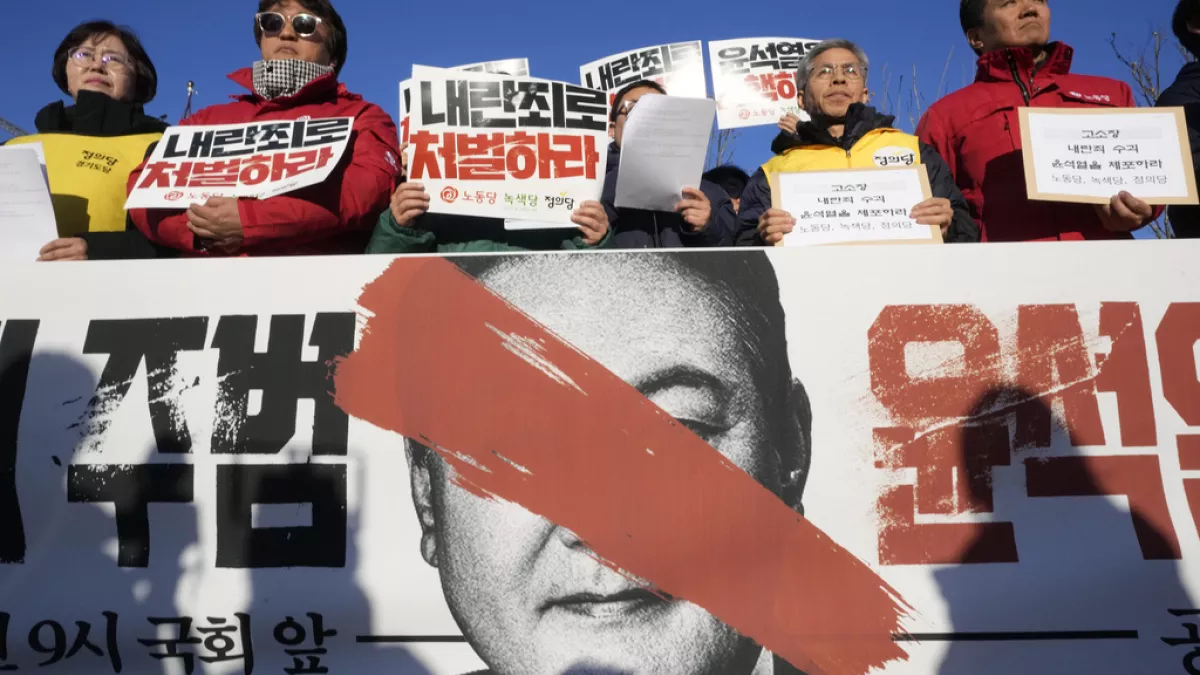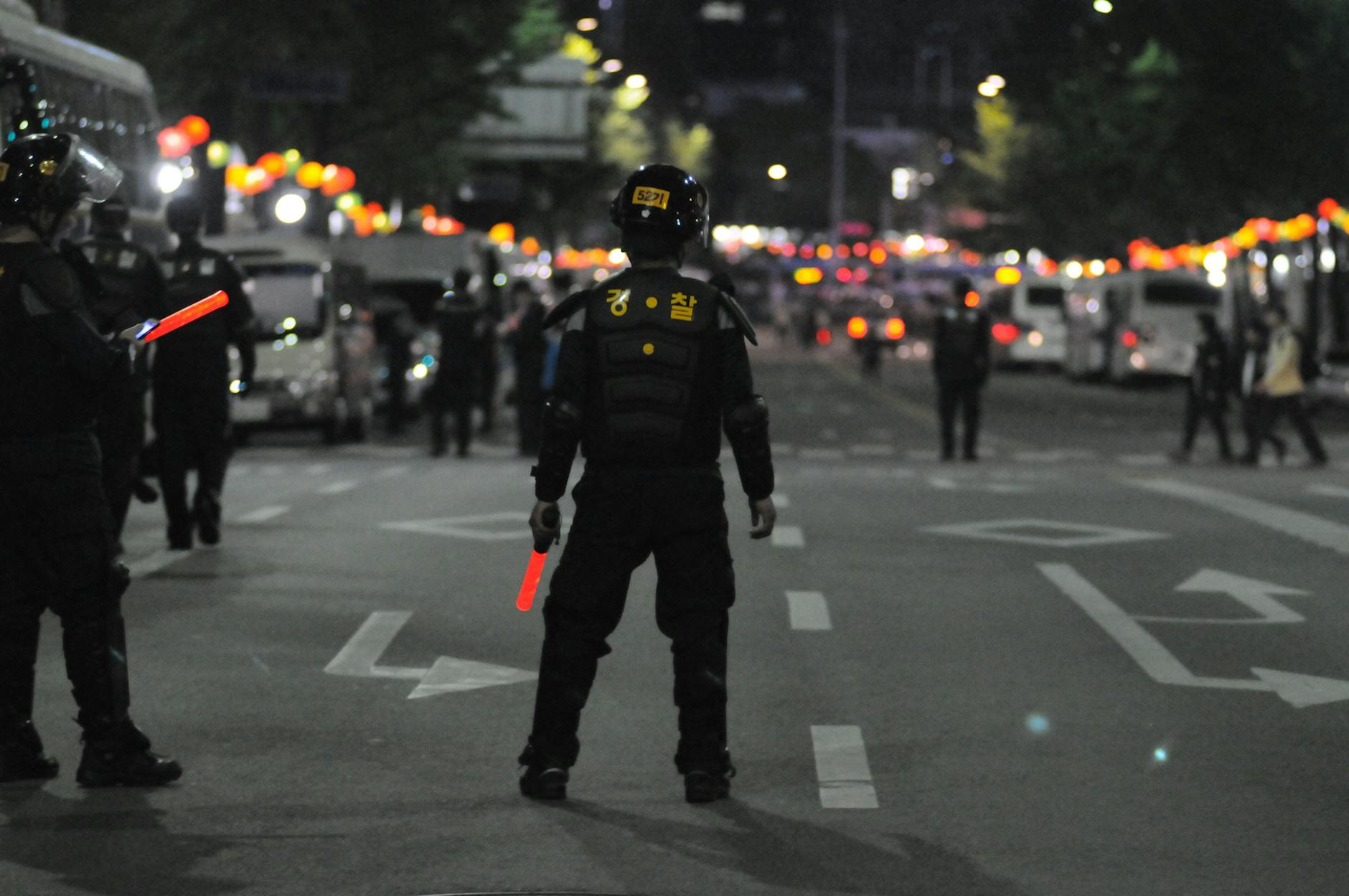
Korea has recently marked the one-year anniversary of former president of the Republic of Korea (ROK) Yoon Suk Yeol’s attempt to declare martial law, stage a self-coup, and seize power over the nation. This last-ditch effort to avoid facing justice for corruption, masterminded by Yoon and handpicked members of the senior military command, ultimately failed. Yoon and his co-conspirators are in jail awaiting the result of extensive efforts that are underway to investigate and prosecute all involved parties.[1] Furthermore, the opposition Democratic Party of Korea (DPK) has come to power with a platform which includes promises of radical democratic reforms and strong mandates to prevent the recurrence of martial law and prosecute those who participated in the plot. Dubbed the “Revolution of Light,” Korea’s victory against authoritarianism and anti-democratic forces was won thanks solely to the Korean people and domestic Korean institutions, while the rest of the world stood by.
In President Lee Jae-Myung’s address during the opening ceremony of the International Political Science Association’s 28th World Congress in Seoul, he issued a call to action for democracies across the world in the face of a rising autocratic threat. President Lee offered the ROK as a model for the future of democracy: “When I was young, I learned that Athens symbolizes democracy, but I want to let the world know that the model for a new type of democracy begins in Seoul.”[2] As evidence, he provided the following: “The basic order of liberal democracy that has been defended by the blood and sweat of the people was trampled on [by the insurrection], but the people clung to hope… The forces behind the insurrection may have broken the windows of the National Assembly, but they could not scratch the will of the people to defend democracy.”[3] As the world grapples with a new wave of authoritarianism, what lessons can be learned from the Korean experience and applied to East Asia and the world more broadly?
The first lesson that can be taken from Korea’s experience is the importance of civic engagement and care for democracy among the population to shield democracy. Above all else, the Revolution of Light in Korea was a revolution led by the people. After Yoon’s declaration, thousands of Koreans rushed from their homes in Seoul and protested at great risk to themselves at the gates of the National Assembly. Aides and regular staff working in the National Assembly building quickly erected barricades and fought against armed soldiers to prevent them from arresting lawmakers, delaying their assault and likely singlehandedly preventing Yoon’s success. Even in the military, low-level commanders instructed their men not to obey their orders and obstructed the efforts of insurrectionist military units.[4] Even beyond the immediate crisis, the population continued to stage massive protests and demonstrations calling for Yoon’s impeachment, pressuring Yoon’s own party, the People Power Party (PPP), to prioritize the people’s needs above their personal interests. Mirroring the earlier popular demonstrations and campaigns for justice that brought down the corrupt Park Geun-hye administration in 2015, the protestors were unwavering in their resolve to defend democracy. As democratic apathy grows and political engagement wanes in the United States, Europe, and elsewhere, the population of Korea—a nation which only achieved democracy in 1987—has repeatedly proven itself as a bulwark between authoritarian impulses and national power, demonstrating a fierce pro-democracy spirit backed by action, not just words.[5] In his address to the nation marking the anniversary of the martial law, President Lee spoke about the role of the people: “The Assembly’s decision to lift martial law, and our military’s faithful implementation of that decision under civilian control, were all made possible because citizens took action themselves. The previous administration’s actions were gravely unjust, but our citizens were exceptionally just. You transformed the worst moment triggered by an unlawful pro-administration coup attempt into the best of moments — not through violence, but through dance and song. With the radiance of your bright clothing, you restored light to a country that had nearly been dragged back into an age of darkness.”[6]
The second lesson that can be learned from the events of December 3rd is that the United States is not an active force for democracy in the region, and especially not in Korea. America’s record in Korea has supportedSyngman Rhee’s election rigging and his declaration of martial law, Park Chung-hee’s coup d’etat and subsequent years of authoritarian rule, and Chun Doo-hwan’s martial law and civilian massacre. Despite repeated electoral manipulation and anti-democratic behaviour by Syngman Rhee, the first president of Korea, the American government remained supportive of him. This support continued even after his government was overthrown by the April Revolution, a popular revolt triggered by Rhee’s declaration of martial law to stay in office after rigging the 1960 presidential election.[7] When the American government heard about the brewing plans for a coup by Park Chung-hee and the military, they decided to stand by and allow the democratically elected government to be overthrown in favour of martial law and an anti-communist military regime, recognizing the new government only two months after the coup.[8] Under Park’s successor Chun Doo-hwan, America’s role in strangling Korean democracy changed from complicity to active participation in repression. This shift was evidenced when military units under American command assisted in the Gwangju Massacre, the bloody assault on the city of Gwangju that killed thousands of civilians protesting for democracy after Chun declared martial law.[9] America’s relationship with Korea during Yoon’s presidency, overseen by the administration of US President Joe Biden, was one of intentional ignorance towards Yoon’s repeated and unapologetic assaults on democracy in exchange for Yoon’s steadfast pro-American stances and rapprochement with Japan.[10] After Yoon declared martial law and vowed to “eradicate” opposition lawmakers, roughly a year after Yoon was warmly embraced by Biden at the White House, the American government was entirely silent. As protestors and soldiers clashed and lawmakers barricaded themselves inside the National Assembly, the American administration––which supposedly prioritized fostering global democracy––issued no statement of support or solidarity. It was only after the Korean people had fought and won that American officials belatedly expressed “grave concern” about the events that had occurred.[11]
One year removed from the darkest day of the Sixth Republic, Korea has made significant strides towards achieving justice and bringing about a new era of democratic rejuvenation. Yet, there remain key milestones that have so far eluded the new government, and that may yet define the post-December 3rd period as either a failure or a success.[12] First and foremost, the trials of Yoon and his collaborators have not concluded and may remain unconcluded for months, if not years. These trials will definitively prove whether Korea can stake a claim to the title of the “new Athens,” as Lee claims, and whether Korea’s strong judicial tradition with regard to former political leaders remains intact. Secondly, the DPK came to power on the promise of massive reforms, most of which have not yet been put in motion. Whether or not the DPK can carry out these major and controversial reforms will determine the level of protection put in place to avoid a resurgence of anti- democratic forces. Despite these caveats, Korea has proven beyond a shadow of a doubt that democracy is here to stay, regardless of any outside influence (or lack thereof).
Alexei Wasylucha is a Contributor for the East Asia Section for Synergy 2025-2026 and is a third-year student majoring in Peace, Conflict, and Justice Studies at the University of Toronto. His research interests are Korean democracy and politics, as well as security issues in East Asia.
Bibliography
Cho, Yongho “Contentious Civil Society and Democratic Resilience in South Korea,” Global Asia, March 2024. https://www.globalasia.org/v19no1/cover/contentious-civil-society-and-democratic-resilience-in-south-korea_youngho-cho.
Clark, Donald N.. “U.S. Role in Kwangju and Beyond,” Los Angeles Times, August 29, 1996.https://www.latimes.com/archives/la-xpm-1996-08-29-me-38742-story.html.
Ji-won, Um “Korea will prove democracy-doubters wrong, says Lee Jae-myung,” Hankyoreh, July 14, 2025.https://english.hani.co.kr/arti/english_edition/e_national/1207847.html.
Kim, C. I. Eugene and Ke-soo Kim, “The April 1960 Korean Student Movement,” The Western Political Quarterly 17, no. 1 (1964): 83–92. https://doi.org/10.2307/445373.
Kim, Heejin, Joyce Lee, and Jack Kim, “South Korea Prosecutor Seeks 10-Year Jail Term for Ex-President Yoon,” Reuters, December 26, 2025,https://www.reuters.com/world/asia-pacific/south-korea-prosecutor-seeks-10-yr-jail-term-ex-president-yoon-over-obstruction-2025-12-26/.
Kim, Taehyun, and Chang Jae Baik. “Taming and Tamed by the United States.” In The Park Chung Hee Era, edited by Byung-Kook Kim and Ezra F. Vogel, 58–84. Harvard University Press, 2011. http://www.jstor.org/stable/j.ctt24hjkq.
Kingston, Shannon K.. “US has ‘grave concern’ as South Korea imposes, then overturns, martial law,” ABC News, December 3rd 2024. https://abcnews.go.com/International/martial-law-order-puts-pressure-us-south-korea/story?id=116415834.
Ku, Chan Mo. “The Martial Law Crisis: How Military Disobedience Helped Save South Korea’s Democracy,” The Diplomat, April 19, 2025.https://thediplomat.com/2025/04/the-martial-law-crisis-how-military-disobedience-helped-save-south-koreas-democracy/.
Park, Joon Ha, “Lee Jae-myung Delivers Address to Mark One-Year Anniversary of Martial Law,” Korea Pro, December 3, 2025.https://koreapro.org/2025/12/lee-jae-myung-delivers-address-to-mark-one-year-anniversary-of-martial-law/.
Shin, Gi-Wook “South Korea’s Democratic Decay,” Journal of Democracy 31, no. 3 (2020): 100-114. https://dx.doi.org/10.1353/jod.2020.0048.
Shin, Mitch “One Year After Martial Law Debacle, South Korea’s New President Vows to Complete ‘Light Revolution,’” The Diplomat, December 3, 2025. https://thediplomat.com/2025/12/one-year-after-martial-law-debacle-south-koreas-new-president-vows-to-complete-light-revolution/.
Footnotes
Heejin Kim, Joyce Lee, and Jack Kim, “South Korea Prosecutor Seeks 10-Year Jail Term for Ex-President Yoon,” Reuters, December 26, 2025, https://www.reuters.com/world/asia-pacific/south-korea-prosecutor-seeks-10-yr-jail-term-ex-president-yoon-over-obstruction-2025-12-26/. ↑
Um Ji-won, “Korea will prove democracy-doubters wrong, says Lee Jae-myung,” Hankyoreh, July 14, 2025. https://english.hani.co.kr/arti/english_edition/e_national/1207847.html.
Um, “Korea will prove democracy-doubters wrong, says Lee Jae-myung.”
Chan Mo Ku, “The Martial Law Crisis: How Military Disobedience Helped Save South Korea’s Democracy,” The Diplomat, April 19, 2025. https://thediplomat.com/2025/04/the-martial-law-crisis-how-military-disobedience-helped-save-south-koreas-democracy/. ↑
- Yongho Cho, “Contentious Civil Society and Democratic Resilience in South Korea,” Global Asia, March 2024. https://www.globalasia.org/v19no1/cover/contentious-civil-society-and-democratic-resilience-in-south-korea_youngho-cho. ↑
Park, Joon Ha, “Lee Jae-myung Delivers Address to Mark One-Year Anniversary of Martial Law,” Korea Pro, December 3, 2025. https://koreapro.org/2025/12/lee-jae-myung-delivers-address-to-mark-one-year-anniversary-of-martial-law/. ↑
C. I. Eugene Kim and Ke-soo Kim, “The April 1960 Korean Student Movement,” The Western Political Quarterly 17, no. 1 (1964): 83–92. https://doi.org/10.2307/445373.
Kim, Taehyun, and Chang Jae Baik. “Taming and Tamed by the United States.” In The Park Chung Hee Era, edited by Byung-Kook Kim and Ezra F. Vogel, 58–84. Harvard University Press, 2011. http://www.jstor.org/stable/j.ctt24hjkq . ↑
Donald N. Clark, “U.S. Role in Kwangju and Beyond,” Los Angeles Times, August 29, 1996. https://www.latimes.com/archives/la-xpm-1996-08-29-me-38742-story.html. ↑
Gi-Wook Shin, “South Korea’s Democratic Decay,” Journal of Democracy 31, no. 3 (2020): 100-114. https://dx.doi.org/10.1353/jod.2020.0048. ↑
Shannon K. Kingston, “US has ‘grave concern’ as South Korea imposes, then overturns, martial law,” ABC News, December 3rd 2024. https://abcnews.go.com/International/martial-law-order-puts-pressure-us-south-korea/story?id=116415834. ↑
Mitch Shin, “One Year After Martial Law Debacle, South Korea’s New President Vows to Complete ‘Light Revolution,’” The Diplomat, December 3, 2025. https://thediplomat.com/2025/12/one-year-after-martial-law-debacle-south-koreas-new-president-vows-to-complete-light-revolution/. ↑