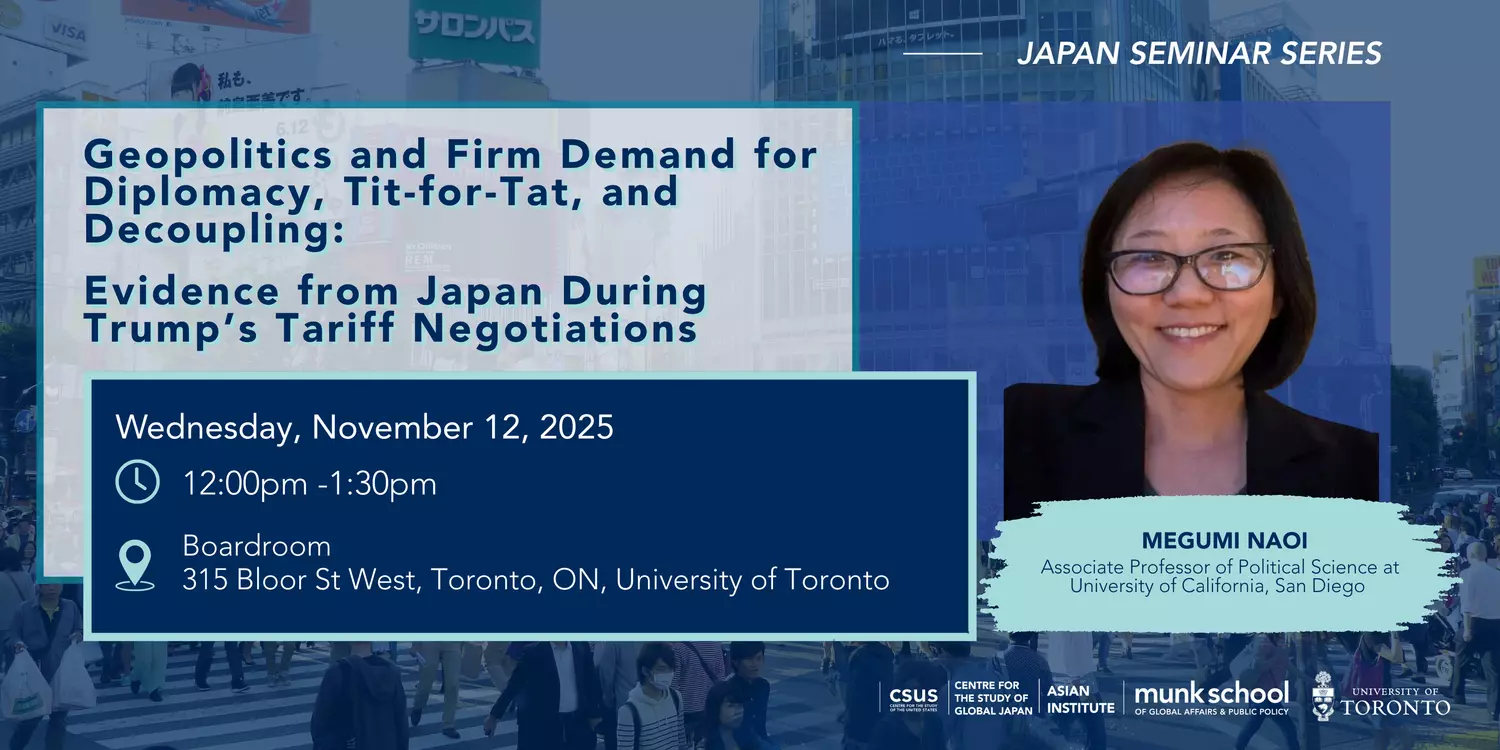
On November 12, 2025, a seminar titled “Geopolitics and Firm Demand for Diplomacy, Tit-for-Tat, and Decoupling: Evidence from Japan During Trump’s Tariff Negotiations” was held in the Board Room at the Munk School of Global Affairs and Public Policy, presented by the Centre for the Study of Global Japan and the Asian Institute. The speaker, Professor Megumi Naoi, Associate Professor of Political Science at the University of California, San Diego, and editorial board member of International Organization and the Journal of Politics, studies international and comparative political economy with focus on trade and redistribution in Japan. Drawing on an original survey experiment conducted in Japan during renewed U.S. tariff threats, she examined how firms evaluate supply-chain disruptions and weigh government responses such as diplomacy, retaliatory protectionism, and decoupling.
Professor Naoi situates her research within rising global protectionism, where economic security is increasingly framed as national security, and protectionist measures are justified as means to safeguard the domestic labor force and vulnerable industries. Yet firms, being most exposed to supply-chain vulnerabilities, do not uniformly endorse such rhetoric, and hence raise the question: what do firms want the government to do? Addressing what firms want governments to do has proven challenging, as existing research conceptualizes economic security in incompatible ways as either a private good according to the international political economy (IPE) tradition, or as a public good according to the international security (IS) tradition, emphasizing firms’ role as compliers to the states’ measures. Professor Naoi’s research seeks to reconcile these viewpoints with an alternative theory that views economic national security as a hybrid of private and public goods through testing firms’ willingness to pay (WTP) for economic protectionist costs via firms’ three potential preferences: diplomacy, tit-for-tat, and decoupling.
Professor Naoi explained three hypotheses that firms may perceive economic security. Hypothesis 1, the contribution hypothesis, understands economic security as public goods akin to national defense, hypothesizing that the higher the level of perceived security threat is, the higher firms’ level WTP will be. The second hypothesis is the private insurance hypothesis, which perceives economic national security as a private good akin to political risk insurance, where the higher the level of perceived policy uncertainty, the higher WTP will be. Hypothesis 3, the hybrid team production hypothesis, points that when firm and government incentives are aligned, firms reduce their own contributions and rely more on government action, thereby lowering their WTP for decoupling.
Professor Naoi also addressed why Japan was an interesting case to study. Being pro-trade and a beneficiary of globalization, Japan has a long tradition of a separated economic and political sphere, making it an ideal case to evaluate corporate behavior under geopolitical stress. For instance, Japanese firms usually maintain positive views towards China, with frequent business travel, production integration, and supply chain preferences. Examining how Japanese firms react to escalating geopolitical tensions involving China could help us understand how firms perceive political allies and non-allies in relation to economic interests.
To gather the dataset, Professor Naoi and her team conducted a large, non-anonymous firm level survey between April and June 2025, during Trump’s “Tariff 2.0” development. The survey sampled 15,000 manufacturing firms and received 1,855 responses. As responses were non-anonymous and collected at the firm level, the study demonstrates high external validity. Firms were presented with hypothetical supply-chain disruptions caused by natural disasters, U.S. policy actions, Chinese policy actions, or actions by allied and non-allied states. The affected party scenarios include the respondent’s own firms, the semiconductor sector, the manufacturing sector, or the Japanese citizens’ daily lives. After each scenario, respondents selected a preferred policy choice between 1) diplomacy/aid, 2) tit-for-tat protectionism, or 3) decoupling via subsidies and loans, and were asked to indicate their preferred government-firm cost-sharing arrangement and acceptable national security tax rate. This survey design enables analysis of firms’ WTP and whether they perceive economic security as a public, private, or hybrid good.
Presenting the preliminary results, Professor Naoi described several patterns in how Japanese manufacturing firms responded to different types of supply chain disruptions. She began by outlining the overall distribution of responses, with diplomacy being the most frequent choice (47.5%), followed closely by decoupling (46.5%), and Tit-for-Tat protectionism receiving relatively low support (~6%). In the interpretation of the results, Professor Naoi selected natural disasters causing disruption as the baseline for comparisons. She explained that in comparison to the baseline, when disruptions were described as occurring due to geopolitical causes, whether it be from an ally or a non-ally, firms became comparatively less likely to choose decoupling. She points out that this pattern contradicts the widespread assumption that geopolitical risks make firms more inclined towards decoupling. Instead, firms appeared to prefer that the government handle disruptions through diplomacy.
Professor Naoi also noted that the survey results revealed little difference between firms’ response towards disruptions attributed to allies compared to disruptions attributed to non-allies. She emphasized that either scenario produced significant divergent effects, a result in contrast to expectations drawn from research on alliances in international relations. Moreover, Professor Naoi expressed that despite the earlier theoretical expectations of firms’ behaviour in scenarios involving themselves and scenarios that do not, the survey’s manipulation of who the victim of the disruption was did not produce consistent differences in policy preferences. Therefore, the survey’s use of public-good or private-good framings did not appear to systemically impact the firms’ choices among the three options.
Regarding WTP, firms generally preferred that the government bear a larger share of decoupling subsidy costs. This preference was even stronger when disruptions were attributed to allies. She noted that this finding contradicts both the contribution hypothesis and the team production hypothesis, which predicted greater firm contributions when government incentives to decouple were weak. Instead, firms favored increased government cost-sharing in ally-originated disruption scenarios. Furthermore, regarding the proposed economic national security tax, nearly half of all the responses selected “0%” as their acceptable rate, with comparatively fewer firms choosing rates above 1-2%. Professor Naoi explained that none of the factors and scenarios significantly affected firms’ willingness to accept a higher tax burden, regardless of the causes of the disruptions.
Addressing a pattern that emerged when the study distinguished firms by their actual production and procurement structures, Professor Naoi noted that nearly 20% of firm respondents neither procured inputs from abroad nor exported any goods. In other words, for the more domestically oriented firms, decoupling was largely hypothetical, and thus they may have appeared more likely to choose tit-for-tat measures.
Professor Naoi reflected that several findings diverged from existing theories, particularly firms’ limited support for decoupling, their indifference between ally and non-ally sources of disruption, and the weak relationship between threat perception or policy uncertainty and policy preferences. She emphasized that these patterns suggest firms may weigh economic national security differently from other policy areas; for instance, firms appeared to be more willing to pay for domestic policies such as disaster relief than economic security measures. She also observed heterogeneity across firms, with a small portion of domestically oriented firms favouring more hawkish responses, potentially linked to differences in global production-chain participation. Looking ahead, she described ongoing work to merge the survey data with METI’s supply-chain census to better assess how supply-chain structures shape firms’ responses and to refine interpretations of the preliminary results.
During the Q&A, attendees raised methodological and conceptual questions regarding the natural-disaster baseline, ally categorization, Japan’s policymaking structure, and firm heterogeneity. Professor Naoi clarified that in the setup, diplomacy was paired with aid to make natural-disaster scenarios plausible, and noted that the Japanese term dōmeikoku was used, which respondents typically associated with the U.S. She also explained that Japan’s centralized trade policymaking enables coordinated responses to global events and that major firms today generally avoid direct political engagement due to previous scandals. Finally, she discussed challenges in incorporating tariff timing into the analysis, given the weekly volatility of the Trump administration’s tariff decisions, though broader descriptive trends remain analyzable.
Photos: 

Yota Wang is an Event Reporter for the Synergy Journal’s East Asia section. Yota is in his second year as an International Relations and Economics student at the University of Toronto, who is interested in researching about economic development strategies and population demographics of East Asian countries.