Keywords: Vietnam; environmental justice; authoritarianism; state–business collusion; Formosa Ha Tinh Steel
Abstract
In 2016, toxic wastewater from the Formosa Ha Tinh Steel plant in central Vietnam triggered one of the country’s worst marine environmental disasters, killing massive quantities of fish and destroying the livelihoods of tens of thousands of coastal residents. This article argues that the Formosa disaster was not an isolated incident, but a revealing outcome of Vietnam’s authoritarian political structure and elite-driven growth model. Drawing on political science, sociology, and economics, the paper shows how the state’s pursuit of rapid industrialization and foreign direct investment weakened environmental enforcement, fostered collusion between officials and corporate actors, and allowed Formosa to evade full accountability. This study examines the economic and social impacts of Formosa on fishing communities, the emergence of large-scale protests and online campaigns such as “I Choose Fish,” and the harsh repression of activists through arrests, surveillance, and legal persecution. This analysis will also situate Formosa within a broader pattern of corporate impunity in the global economy by considering transnational legal efforts in Taiwanese courts. Taken together, the Formosa case demonstrates how censorship, corruption, state–business collusion produce environmental injustice and raises urgent questions about how affected communities can pursue justice under authoritarian rule.
Introduction
Vietnam’s rapid economic development over the past few decades has transformed the country into a growing industrial hub in Southeast Asia. However, this growth has also presented complex challenges, particularly in balancing economic priorities and environmental protection. Operating under a one-party political system, Vietnam’s leadership maintains firm control over both the economy and regulatory institutions, including those responsible for enforcing environmental laws. While ecological regulations exist on paper, they are often weakly enforced, especially when powerful investors are involved.[1] These conditions helped shape the 2016 Formosa environmental disaster, when a steel plant released toxic waste into the ocean, devastating coastal communities and marine life.[2] In the aftermath, dozens of activists were arrested or imprisoned for speaking out. This disaster raises urgent questions: Why was such large-scale pollution allowed to occur despite existing regulations being in place? Moreover, how did the Vietnamese political system help Formosa avoid full accountability and suppress criticism? This paper argues that the 2016 Formosa disaster is not an isolated incident but a revealing outcome of Vietnam’s authoritarian political structure and elite-driven economic priorities. This article demonstrates how the government’s focus on economic growth weakened environmental enforcement, fostered close relationships between state officials and corporations, and led to censorship and repression. Together, these dynamics reveal how regime stability and investor confidence were prioritized over environmental protection and the rights of citizens.
Vietnam and the 2016 Formosa Spill
Vietnam is a one-party socialist state that has embraced rapid economic growth since launching its Đổi Mới reforms in 1986.[3] These reforms transitioned the country from a centrally planned economy to one integrated into global markets, attracting foreign investment and infrastructure development. However, Vietnam’s economic model has also been criticized for suppressing fundamental rights, such as freedom of speech, association, and protest, and for prioritizing the interests of elites and investors over those of local communities.[4]
Formosa Plastics Group originally proposed building a steel plant in Taiwan in 2004.[5] Although the project was marked as a national investment priority, Taiwan’s Environmental Impact Assessment Committee raised concerns about its potential environmental harm and recommended a second-stage review. To avoid delays and public opposition, and attracted by lower construction and labour costs abroad, the company decided to relocate the project to Vietnam instead.[6] In 2008, construction began on the Formosa Ha Tinh Steel (FHS) plant in the Vung Ang Economic Zone in Hà Tĩnh Province. Promoted as one of the most significant foreign direct investments in Vietnam, the project benefited from favourable tax policies, low labour costs, and tariff advantages through ASEAN.[7]
In April 2016, approximately 100 tons of dead fish washed ashore along a 200-kilometre stretch of Vietnam’s central coastline. The disaster struck four provinces: Ha Tinh, Quang Binh, Quang Tri, and Thua Thien–Hue. Approximately 44,000 families, primarily those reliant on fishing and farming, were affected.[8] More than 2,600 fishing boats were grounded, and local unemployment rates rose to fifteen times the norm. By the end of 2016, 83% of residents in the affected provinces had experienced a decline in income.[9]
The Vietnamese government initially denied any connection between the fish deaths and the Formosa plant. However, mounting public pressure, including protests and citizen reports, forced an official investigation. On July 4, 2016, authorities confirmed that untreated wastewater from the FHS mill had discharged toxins, including cyanide and phenols, into the sea.[10] Only after two months of national unrest did Formosa’s chairman issue a public apology and pledge US$500 million for environmental cleanup and compensation.[11]
Despite the company’s payment, numerous communities were left without adequate or direct compensation. The payment was sent to the central government rather than directly to the victims. Within two months, only a small number of families had received the promised 650 USD per household, and local officials were accused of mismanaging or misappropriating the funds.[12] No senior executives or high-ranking Vietnamese officials were held accountable. Instead, rumours circulated that local authorities involved in the project or disbursing funds were benefiting personally, illustrating how enforcement collapsed under the pressure of corruption.
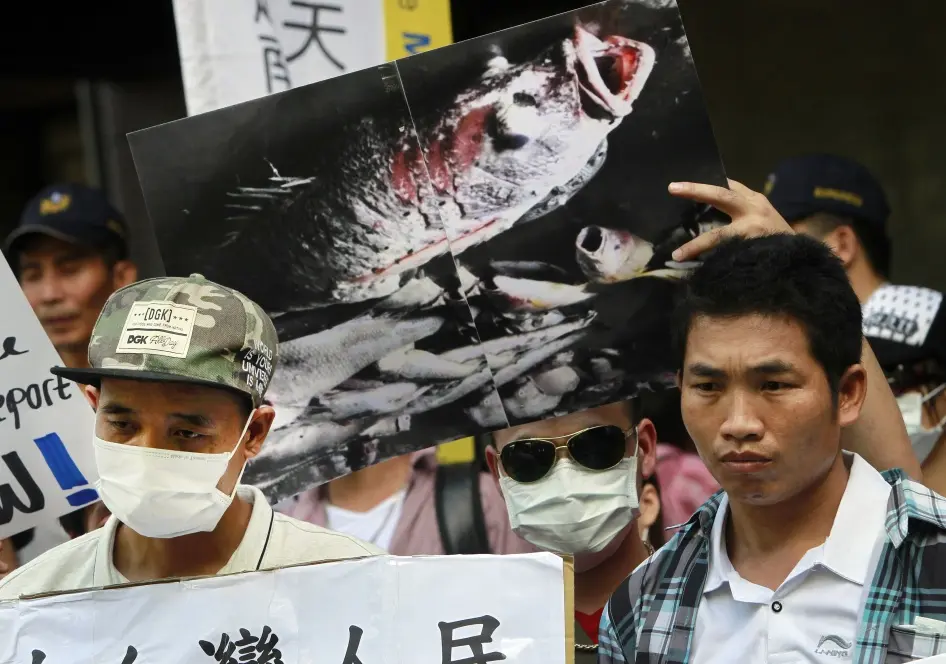
Frustration over the lack of accountability quickly erupted into one of the most significant environmental protest movements in Vietnam’s recent history. In May 2016 and the months that followed, thousands of citizens, from young to old, took to the streets of Hanoi, Ho Chi Minh City, and Da Nang, as well as coastal villages, to demand investigations and justice.[13] Protestors carried banners quoting the constitution and used smartphones to document events for the media.[14] Notably, several large demonstrations were organized without formal leadership or NGO backing, utilizing Facebook and chat groups to organize and broadcast the events.[15] Despite being largely peaceful, the protests were quickly and violently suppressed. Police broke up rallies, detained protestors, and carried out mass arrests.[16] By year’s end, dozens of activists and community leaders had been imprisoned for “anti-state propaganda” or other vague charges related to speaking out about Formosa.[17]
Authoritarian Environmentalism and the Cost of Industrial Ambition
Vietnam’s pursuit of rapid economic growth under an authoritarian system has fostered close ties between the state and powerful corporations, creating conditions where environmental regulations are routinely ignored and polluters are protected. Following the Đổi Mới reforms in 1986 [18], Vietnam underwent a shift from a centrally planned system to a market-oriented economy, led by the one-party Communist state. In this context, rapid economic growth and foreign direct investment (FDI) became the government’s highest priorities, even when these objectives conflicted with environmental protection. [19] Over the past decade alone, Vietnam has attracted over $70 billion in FDI, a trend that top officials have enthusiastically promoted as essential to modernization and national development.[20] The Formosa Ha Tinh Steel project exemplifies this development-first model. Backed by the Taiwanese company Formosa Plastics Group, the $10.6 billion project received significant support from the Vietnamese government. The government granted Formosa a 70-year land lease, along with sweeping tax exemptions, including those on both imported machinery and domestically sourced materials such as bricks and cables, as well as fast-tracked approval processes.[21] These benefits created a deeply entangled relationship between state officials and corporate actors, where the project’s success was tied to the government’s legitimacy and economic reputation.
This alignment helps explain why the state was reluctant to enforce intense regulatory action, even after the disaster. Scholars describe Vietnam’s model as “authoritarian environmentalism,” where top-down state agencies control environmental policy with minimal public participation.[22] Although Vietnam has environmental regulations in place, they are not always enforced, especially when powerful companies are involved. Because government offices are often hard to deal with and do not respond to the public, many people turn to protests to make their voices heard. As Bruun argues, environmental decision-making in Vietnam is concentrated among elite actors who prioritize investor relations over grassroots accountability.[23] In the case of Formosa, state officials were caught between public outrage and the need to appease investors. Instead of punishing Formosa’s top executives or removing government officials who failed to act, they devised a middle-ground solution: the company paid $500 million and temporarily shut down the plant, without issuing formal admissions of guilt or facing prosecution.[24] No senior official lost her job, and no Formosa executive was prosecuted under Vietnamese law.
Corruption and state-business collusion further undermined the effectiveness of the legal response. Vietnam ranks poorly on global corruption indices, with watchdogs like Transparency International highlighting systemic weaknesses in oversight. The Formosa compensation was negotiated without public consultation and distributed through opaque channels. [25]Victims encountered inconsistent documentation requirements and unclear criteria for eligibility, with many ultimately excluded from receiving support. [26]Due to the lack of judicial independence in Vietnam, people harmed by the disaster had no neutral place to appeal the settlement or pursue legal remedies.[27]
The Formosa case is another example of how the government and large businesses in Vietnam often collaborate for their mutual benefit. For example, the collapse of Vinashin, a state-owned shipbuilding company, in 2010 highlighted how political interference and a lack of transparency contributed to a financial disaster. Criminal charges were brought only after massive debt and public scandal.[28] Likewise, Formosa Plastics Group has a global record of environmental violations. In the United States, its subsidiaries have been fined for releasing hazardous substances into waterways.[29] Despite this record, Vietnam’s government welcomed the company with open arms, framing it as a symbol of progress and industrial strength.[30]
Ultimately, the Formosa disaster illustrates a broader tension within Vietnam’s political economy: the government’s dual role as both economic promoter and environmental regulator creates a fundamental conflict of interest. In prioritizing foreign investment and economic expansion, the government has often disregarded proper rules and failed to consult the public. The close ties between political elites and corporate actors result in a system where polluters are shielded and citizens are silenced. The disaster is not merely a failure of one company; it reveals a larger system in which the government and large businesses collaborate in ways that harm people and the environment.
Economic and Social Impacts
The severe economic fallout from the Formosa disaster illustrates how Vietnam’s authoritarian growth model sacrificed the livelihoods of coastal communities to protect elite interests and foreign investment. Two of the region’s most important sources of income, fishing and tourism, collapsed almost overnight. The impacts on human lives were devastating. Vietnam officials reported hundreds of tons of marine life lost, and fishing communities saw their income and employment plummet. Affected fishermen reported catching only “fish bones” for weeks.[31] The Vietnam Fisheries Association warned that “seafood farming [was] impossible and the tourism industry [was] also affected,” with no alternative jobs for fishermen.[32] In short, the spill destroyed key industries in four provinces and caused long-term financial harm to tens of thousands of workers.
These destructive effects rippled across related industries such as boat repair shops, seafood markets, and small hotels. Drawing on field research, there are significant job losses and economic displacement, with poorer fishermen suffering the most severe impacts. While wealthier boat owners could relocate to unaffected waters, poorer fishers were often left with no choice but to abandon their trade and take low-paying jobs inland. [33]
Although official Vietnamese government reports claim that only 322 tons of marine life were lost in 2016, independent estimates suggest the real figure was much higher.[34] The spill’s consequences extended far beyond lost income; it raised serious concerns about food safety, long-term health effects, and the forced migration of entire communities. Families feared contaminated seafood, and some were compelled to sell their boats, homes, or other assets to make ends meet.[35]
The $500 million compensation package negotiated with Formosa appears grossly inadequate when viewed against the scale of the damage. A simple division of that amount among roughly 40,000 affected families would leave each household with around $12,500 before administrative fees, far less than the long-term livelihoods many families lost. Worse still, only a few families initially received the promised payments, and bureaucratic hurdles, unclear eligibility rules, and corruption left many victims without support. [36] Critics noted that the settlement was reached before any complete environmental or economic damage assessment had been conducted, highlighting the state’s priority to contain the situation politically rather than address it fairly.[37]
This outcome reflects what economists refer to as a negative externality. A negative externality occurs when a company causes harm, such as pollution, but does not bear the full cost of its actions.[38] In a more transparent or democratic system, environmental regulations or “polluter-pays” laws might require companies to compensate for their damage fully. However, in Vietnam’s authoritarian system, investor protection took precedence. By offering a fixed compensation package without prosecuting those responsible, the government shifted the burden of recovery onto affected communities rather than the polluter itself. [39]
The practice of letting companies avoid responsibility for environmental damage, while poorer communities suffer the consequences, is not just a problem in Vietnam. It is part of a larger global pattern linked to how the world economy works. A comparable example can be found in Nigeria’s Niger Delta, where decades of oil extraction by international companies have led to repeated environmental disasters. Oil pollution in the region significantly reduced fish production, severely undermining the livelihoods of local fishing communities.[40] Like in the Formosa case, the government and foreign investors made big profits, but the local people were left to deal with the damage.
Nevertheless, this approach is increasingly out of step with public opinion. Contrary to the belief that citizens in developing countries are willing to trade environmental protection for economic growth, recent research suggests otherwise. Vietnamese citizens do not prioritize development over nature blindly.[41] In fact, one study demonstrates that the greater the environmental costs associated with an investment, the less likely people are to support it, regardless of economic benefits. This broad concern for environmental quality, present across income levels and regions, reflects a growing preference for sustainability over short-term economic gain.[42] Despite this shift in public attitudes, the government prioritized political stability and investor confidence over justice or long-term recovery. The result is a prominent example of how economic growth under an authoritarian model can deepen inequality and environmental injustice, with citizens bearing the hidden costs of elite decisions.[43]
Civil Mobilization
The government’s harsh response to post-Formosa protests illustrates how public dissent in Vietnam is treated not as a legitimate demand for justice but as a direct threat to authoritarian control and the regime’s economic priorities. On May 1, 2016, thousands of citizens, including fishermen, students, religious communities, and environmental groups, took to the streets in Hanoi, Ho Chi Minh City, Da Nang, and coastal villages, carrying signs that read “Formosa out of Vietnam!” and “If the sea dies, we die!”[44] In one event, over 4,000 people surrounded the Formosa compound to demand accountability, showing that environmental concerns had sparked one of the largest displays of public dissent in recent history.
One of the most striking symbols of this public protest movement was the viral slogan “I Choose Fish,” which responded to a reported statement by Formosa that Vietnam must “choose between fish and steel.” [45] The campaign quickly spread on Facebook, where users shared the hashtag #IChooseFish and overlaid images of fish on the Vietnamese flag to advocate for environmental protection over industrial expansion.[46] Facebook’s role in amplifying public outrage marked a turning point, as digital platforms began to rival state-controlled media in shaping public opinion. Social media has become a critical space for civic expression in Vietnam, enabling “previously marginalized voices” to challenge official narratives and demand transparency.[47]
However, this wave of civic mobilization was met with swift and severe repression. By mid-2016, the Vietnamese government had detained hundreds of protestors and petitioners. At least 41 activists were sentenced to lengthy prison terms, ranging from 9 to 14 years, on charges such as “anti-state propaganda” and “abusing democratic freedoms”.[48] Prominent cases included that of legal advocate Pham Doan Trang, who received a nine-year sentence for publishing an independent report on the spill, and labour organizer Hoang Duc Binh, who was sentenced to 14 years for assisting fishermen in submitting legal claims. Even logistical supporters, such as drivers and event organizers, faced arrest and imprisonment.[49] The government framed these protests as subversive, with officials accusing foreign-backed groups of using the disaster to destabilize the regime.[50] To defuse public outrage, the government staged publicity efforts, such as high-ranking officials swimming at the polluted site and consuming local seafood to demonstrate its safety, actions that were widely perceived as disingenuous.[51]
Legal mechanisms were also used to suppress dissent. Article 88 of Vietnam’s Penal Code, which criminalizes “propaganda against the state,” was invoked to prosecute activists like Trang. Public demonstrations were broken up with force. In Hanoi, police confined protesters to a short symbolic march, while in Ho Chi Minh City, plainclothes officers detained participants en masse; reports indicated that over 500 individuals were arrested in a single day.[52] Even after public protests subsided, targeted surveillance and harassment of activists continued, underscoring the state’s intent to deter future mobilizations.
The Formosa protests illustrate how authoritarian governments may permit limited civil expression only when it poses no threat to elite interests. State officials in Vietnam are sensitive to performance legitimacy and uy tín, which refers to their reputation for moral governance and effective leadership.[53] When confronted with strong sustainability claims, such as demands for transparency and accountability, officials may engage in symbolic acts like public apologies or disciplining mid-level bureaucrats. This was used in the Formosa case to frame the government as responsive to public outcry while avoiding deeper accountability.[54] These gestures are not rooted in democratic principles but are strategic moves aimed at preserving the regime’s prestige and social stability in the face of dissent. At the same time, Vietnam’s media remains tightly controlled despite commercialization. [55] Journalists can only report on environmental issues when their narratives align with the interests of the state. This media environment enabled the government to shape public perception, downplay Formosa’s liability, and avoid broader accountability. In the end, although the protests reflected the resilience of Vietnam’s civil society, it was ordinary citizens who lost their livelihoods or freedom who were left to bear the burden of a disaster shaped not only by corporate negligence but also by systemic state repression.
Transnational Legal Struggles and Comparative Perspectives
The Formosa disaster highlights how the combination of authoritarian governance and weak transnational legal mechanisms enables powerful corporations to evade accountability, rendering environmental justice a complex and uneven struggle that transcends borders. As the parent company is headquartered in Taiwan, many Vietnamese victims turned to Taiwanese courts after facing limited options at home. In 2019, nearly 8,000 victims filed a transnational lawsuit in Taipei, Taiwan.[56] While initial lower court rulings dismissed the case on jurisdictional grounds, Taiwan’s Supreme Court later reversed the decision, and the High Court recognized jurisdiction based on the residence of Formosa’s executives in Taiwan. [57] This ruling was a rare breakthrough in transnational litigation, signalling a shift toward holding multinational corporations accountable in their home states.[58] However, these legal efforts were not free from interference. Victims attempting to gather necessary documents for the lawsuit encountered bureaucratic obstacles and intimidation from the state. Even when legal doors opened, political pressure made justice hard to reach.[59]
This pattern of corporate impunity does not just happen in Vietnam. Around the world, companies have followed suit. In Ecuador, for instance, indigenous communities in Lago Agrio won a $9.5 billion judgment against Chevron for decades of oil contamination in the Amazon rainforest. Nevertheless, Chevron evaded enforcement through international arbitration and legal maneuvering in U.S. courts, leaving many victims without compensation.[60] Similarly, Formosa Plastics has faced pollution controversies in Cambodia, Texas, and other locations, where it has frequently escaped full liability despite documented harm.[61]
Although Vietnam’s authoritarian system makes it harder for victims to speak out, the deeper issue lies in how international law is structured to serve corporate interests. Weak enforcement, cross-border legal barriers, and political influence often make justice an uneven and uphill battle for communities harmed by multinational companies.
Conclusion
The 2016 Formosa disaster exposed how Vietnam’s authoritarian politics and elite-driven economic priorities can produce devastating consequences for both people and the environment. As this paper has demonstrated, the close ties between the state and corporate actors, evident in tax breaks, regulatory leniency, and political protection, enabled Formosa to evade full accountability. When the disaster unfolded, the government prioritized appeasing large investors over supporting the communities that were harmed. At the same time, public dissent was met with censorship and repression. With no formal avenues to seek justice, citizens turned to protests and online campaigns, only to face arrest, surveillance, and intimidation. Together, these dynamics suggest a system in which censorship, corruption, and corporate influence mutually reinforce one another. The Formosa case is not an exception but a clear example of how economic growth, when pursued without transparency or public accountability, can lead to environmental injustice and human suffering. It also offers a broader lesson that even when ecological laws exist, they can be undermined by political and economic power structures that shield polluters from consequences.
Looking ahead, a pressing question remains: how can individuals and the global community advocate for justice in countries where speaking out carries serious risks? Future studies could explore ways to utilize international legal systems, such as lawsuits in the company’s home country or specialized courts that focus on human rights. They could also explore ways to support environmental groups operating in countries with repressive regimes. Comparative studies with other countries facing similar challenges may reveal both shared patterns and strategies for resistance.
Ultimately, the Formosa disaster serves as a warning. Without structural reforms that empower communities and break the ties between governments and corporations, disasters like this will continue to occur. The question “fish or steel” should not be a forced choice. Justice requires that both environmental protection and human dignity are non-negotiable.
Han Tran is a Student at the University of Toronto and a Guest Author for Synergy‘s 2025 Fall Cycle.
Bibliography
Bruun, Ole. 2020. “Environmental Protection in the Hands of the State: Authoritarian Environmentalism and Popular Perceptions in Vietnam.” Journal of Environment & Development 29, no. 2: 171–95. https://doi.org/10.1177/1070496520905625.
Fan, Mei-Fang, Chih-Ming Chiu, and Leslie Mabon. 2022. “Environmental Justice and the Politics of Pollution: The Case of the Formosa Ha Tinh Steel Pollution Incident in Vietnam.” Environment and Planning E: Nature and Space 5, no. 1: 189–206. https://doi.org/10.1177/2514848620973164.
Gillespie, John, Thang Nguyen, Canh Le, and Hung Nguyen. “From ‘Weak’ to ‘Strong’ Sustainability: Protesting for Environmental Justice in Vietnam.” Journal of Vietnamese Studies 14, no. 3 (2019): 1–42. https://www.jstor.org/stable/26859468.
Gossman, Patricia. 2024. “Victims of Vietnam’s Formosa Toxic Spill Deserve Justice.” Human Rights Watch, May 14, 2024. https://www.hrw.org/news/2024/05/14/victims-vietnams-formosa-toxic-spill-deserve-justice.
Grinter, Lawrence E. “Vietnam’s Thrust into Globalization: ‘Doi Moi’s’ Long Road.” Asian Affairs 33, no. 3 (2006): 151–65. http://www.jstor.org/stable/30173023.
Ho, Jessie. “Formosa Chooses Changhua for Site of Steel Refinery.” Taipei Times, March 6, 2004. https://www.taipeitimes.com/News/biz/archives/2004/03/06/2003101390
Hoang, Trung Xuan, Dinh Thi Le, Hoa Minh Nguyen, and Ngoc Duyen Thi Vuong. 2020. “Labour Market Impacts and Responses: The Economic Consequences of a Marine Environmental Disaster.” Journal of Development Economics 145: 102538. https://doi.org/10.1016/j.jdeveco.2020.102538.
International Federation for Human Rights (FIDH). 2019. “Urgent Resolution on Environmental Justice in Vietnam.” FIDH 40th Congress Statement (Taipei), November 18, 2019. https://www.fidh.org/en/region/asia/vietnam/urgent-resolution-on-environmental-justice-in-vietnam.
Minh, Ho Binh. 2016. “Rare Rallies in Vietnam over Mysterious Mass Fish Deaths.” Reuters, May 1, 2016. https://www.reuters.com/article/us-vietnam-environment-protests-idUSKCN0XS0BQ.
Nguyen, Thieu-Dang, and Simone Datzberger. 2018. “The Environmental Movement in Vietnam: A New Frontier of Civil Society Activism?” Transnational Institute, May 7, 2018. https://www.tni.org/en/publication/the-environmental-movement-in-vietnam.
Nguyen-Thu, Giang. “Vietnamese Media Going Social: Connectivism, Collectivism, and Conservatism.” The Journal of Asian Studies 77, no. 4 (2018): 895–908. https://www.jstor.org/stable/26572578.
Nguyen-Van-Quoc, Thai, and Elen-Maarja Trell. 2023. “’I Choose Fish’: Understanding Informal Civil Society in Vietnam through Environmental Grievances and Actions.” Environment and Planning C: Politics and Space 41 (4): 656–676. https://doi.org/10.1177/23996544221148032.
Nguyen, Quynh, and Edmund Malesky. “Fish or Steel? New Evidence on the Environment-Economy Trade-off in Developing Vietnam.” World Development 147 (2021). https://doi.org/10.1016/j.worlddev.2021.105603.
Ortmann, Stephan. 2023. “When Protests Become a Threat to Authoritarian Rule: The Case of Environmental Protests in Vietnam.” Third World Quarterly 44, no. 9: 2063–79. https://doi.org/10.1080/01436597.2023.2215705.
Osuagwu, Eze Simpson, and Eseoghene Olaifa. 2018. “Effects of Oil Spills on Fish Production in the Niger Delta.” PLOS ONE 13, no. 10: e0205114. https://doi.org/10.1371/journal.pone.0205114.
Philip, Bruno. “Colère Au Vietnam Après La Découverte De Millions De Poissons Morts Sur Les Plages.” Le Monde, May 5, 2016. https://www.lemonde.fr/asie-pacifique/article/2016/05/05/colere-au-vietnam-apres-la-decouverte-de-millions-de-poissons-morts-sur-les-plages_4914369_3216.html.
Po, Chia-Yun. 2022. “Vietnam Marine Life Disaster: A Test Case of a Home State’s Jurisdiction in Taiwan.” Business and Human Rights Journal 7, no. 2: 303–10. https://doi.org/10.1017/bhj.2022.20.
Reporter, Guardian Staff. “Vietnam Blames Toxic Waste Water From Steel Plant for Mass Fish Deaths.” The Guardian, October 29, 2021. https://www.theguardian.com/environment/2016/jul/01/vietnam-blames-toxic-waste-water-fom-steel-plant-for-mass-fish–deaths#:~:text=Vietnam%E2%80%99s%20government%20has%20said%20toxic,rapid%20growth%20in%20foreign%20investment.
“Two Vietnamese Shipbuilding Execs Arrested on Corruption Charges.” The Maritime Executive. December 11, 2018. https://maritime-executive.com/article/two-vietnamese-shipbuilding-execs-arrested-for-corruption
Vahlsing, Marissa. “Lago Agrio Case Pits International Human Rights against International Commercial Law.” EarthRights International, February 16, 2012. https://earthrights.org/blog/lago-agrio-case-pits-international-human-rights-against-international-commercial-law/
VietNamNet Bridge. “What Is Formosa Doing in Vietnam?” VietNamNet Global, July 7, 2016. https://vietnamnet.vn/en/what-is-formosa-doing-in-vietnam-E159915.html
Việt Nam News. “Formosa Pollution Acted Upon.” Việt Nam News, July 18, 2016. https://vietnamnews.vn/environment/299770/formosa-pollution-acted-upon.html.
Vietnam Plus (VNA). 2014. “Taiwan-invested Steel Project Formosa Given Tax Breaks.” VietnamPlus, June 16, 2014. https://en.vietnamplus.vn/taiwan-invested-steel-project-formosa-given-tax-breaks-post61821.vnp
Footnotes
Ole Bruun, “Environmental Protection in the Hands of the State: Authoritarian Environmentalism and Popular Perceptions in Vietnam,” Journal of Environment & Development 29, no. 2 (2020): 176, https://doi.org/10.1177/1070496520905625 ↑
Vietnam Blames Toxic Waste Water From Steel Plant for Mass Fish Deaths.” The Guardian, October 29, 2021. https://www.theguardian.com/environment/2016/jul/01/vietnam-blames-toxic-waste-water-fom-steel-plant-for-mass-fish-deaths#:~:text=Vietnam%E2%80%99s%20government%20has%20said%20toxic,rapid%20growth%20in%20foreign%20investment. ↑
Lawrence E. Grinter, “Vietnam’s Thrust into Globalization: ‘Doi Moi’s’ Long Road,” Asian Affairs 33, no. 3 (2006): 154, http://www.jstor.org/stable/30173023 ↑
Mei-Fang Fan, Chih-Ming Chiu, and Leslie Mabon, “Environmental Justice and the Politics of Pollution: The Case of the Formosa Ha Tinh Steel Pollution Incident in Vietnam,” Environment and Planning E: Nature and Space 5, no. 1 (2022): 193, https://doi.org/10.1177/2514848620973164 ↑
Jessie Ho, “Formosa Chooses Changhua for Site of Steel Refinery,” Taipei Times, March 6, 2004, https://www.taipeitimes.com/News/biz/archives/2004/03/06/2003121234 ↑
Ibid. 193 ↑
Ibid. 193 ↑
Chia-Yun Po, “Vietnam Marine Life Disaster: A Test Case of a Home State’s Jurisdiction in Taiwan,” Business and Human Rights Journal 7, no. 2 (2022): 306, https://doi.org/10.1017/bhj.2022.20 ↑
“Formosa Pollution Acted Upon,” Việt Nam News, July 18, 2016, https://vietnamnews.vn/environment/299770/formosa-pollution-acted-upon.html ↑
Po, “Vietnam Marine Life Disaster.” 306. ↑
Patricia Gossman, “Victims of Vietnam’s Formosa Toxic Spill Deserve Justice,” Human Rights Watch, May 14, 2024, https://www.hrw.org/news/2024/05/14/victims-vietnams-formosa-toxic-spill-deserve-justice ↑
Ibid. ↑
Ho Binh Minh, “Rare Rallies in Vietnam over Mysterious Mass Fish Deaths,” Reuters, May 1, 2016, https://www.reuters.com/article/us-vietnam-environment-protests-idUSKCN0XS0BQ ↑
Thieu-Dang Nguyen and Simone Datzberger, “The Environmental Movement in Vietnam: A New Frontier of Civil Society Activism?” Transnational Institute, May 7, 2018, https://www.tni.org/en/publication/the-environmental-movement-in-vietnam ↑
Ibid. ↑
Ibid. ↑
Stephan Ortmann, “When Protests Become a Threat to Authoritarian Rule: The Case of Environmental Protests in Vietnam,” Third World Quarterly 44, no. 9 (2023): 2068, https://doi.org/10.1080/01436597.2023.2215705. ↑
Grinter, “Vietnam’s Thrust into Globalization,” 154. ↑
“Vietnam Blames Toxic Waste Water,” The Guardian. ↑
Ibid. ↑
VietnamPlus (VNA), “Taiwan-Invested Steel Project Formosa Given Tax Breaks,” VietnamPlus, June 16, 2014, https://en.vietnamplus.vn/taiwan-invested-steel-project-formosa-given-tax-breaks-post61821.vnp. ↑
Bruno Philip, “Colère au Vietnam Après la Découverte de Millions de Poissons Morts sur les Plages,” Le Monde, May 5, 2016, https://www.lemonde.fr/asie-pacifique/article/2016/05/05/colere-au-vietnam-apres-la-decouverte-de-millions-de-poissons-morts-sur-les-plages_4914369_3216.html. ↑
Bruun, “Environmental Protection in the Hands of the State,” 190. ↑
Ibid ↑
International Federation for Human Rights (FIDH), “Urgent Resolution on Environmental Justice in Vietnam,” FIDH 40th Congress Statement (Taipei), November 18, 2019, https://www.fidh.org/en/region/asia/vietnam/urgent-resolution-on-environmental-justice-in-vietnam ↑
Ibid. ↑
International Federation for Human Rights (FIDH), “Urgent Resolution on Environmental Justice in Vietnam.” ↑
“Two Vietnamese Shipbuilding Execs Arrested on Corruption Charges,” The Maritime Executive, December 11, 2018, https://maritime-executive.com/article/two-vietnamese-shipbuilding-execs-arrested-for-corruption ↑
Guardian Staff Reporter, “Vietnam Blames Toxic Waste Water.” ↑
VietNamNet Bridge, “What Is Formosa Doing in Vietnam?” VietNamNet Global, July 7, 2016, https://vietnamnet.vn/en/what-is-formosa-doing-in-vietnam-E159915.html ↑
“Vietnam Blames Toxic Waste Water.” The Guardian. ↑
Ibid. ↑
Trung Xuan Hoang, Dinh Thi Le, Hoa Minh Nguyen, and Ngoc Duyen Thi Vuong, “Labour Market Impacts and Responses: The Economic Consequences of a Marine Environmental Disaster,” Journal of Development Economics 145 (2020): 2, https://doi.org/10.1016/j.jdeveco.2020.102538 ↑
“Vietnam Blames Toxic Waste Water.” The Guardian. ↑
Hoang et al., “Labour Market Impacts and Responses.” 3. ↑
Gossman, “Victims of Vietnam’s Formosa Toxic Spill.” ↑
International Federation for Human Rights (FIDH), “Urgent Resolution on Environmental Justice in Vietnam,” FIDH 40th Congress Statement (Taipei), November 18, 2019, https://www.fidh.org/en/region/asia/vietnam/urgent-resolution-on-environmental-justice-in-vietnam ↑
Bruun, “Environmental Protection in the Hands of the State,” 185.
Ibid ↑
Eze Simpson Osuagwu and Eseoghene Olaifa, “Effects of Oil Spills on Fish Production in the Niger Delta,” PLOS ONE13, no. 10 (2018): 3, https://doi.org/10.1371/journal.pone.0205114 ↑
Nguyen, Quynh, and Edmund Malesky. “Fish or Steel? New Evidence on the Environment-Economy Trade-off in Developing Vietnam.” World Development 147 (2021). https://doi.org/10.1016/j.worlddev.2021.105603. ↑
Ibid. ↑
Thai Nguyen-Van-Quoc and Elen-Maarja Trell, “‘I Choose Fish’: Understanding Informal Civil Society in Vietnam through Environmental Grievances and Actions,” Environment and Planning C: Politics and Space 41, no. 4 (2023): 659, https://doi.org/10.1177/23996544221148032 ↑
Bruno Philip, “Colère au Vietnam Après la Découverte de Millions de Poissons Morts sur les Plages,” Le Monde, May 5, 2016, https://www.lemonde.fr/asie-pacifique/article/2016/05/05/colere-au-vietnam-apres-la-decouverte-de-millions-de-poissons-morts-sur-les-plages_4914369_3216.html ↑
Nguyen-Van-Quoc and Trell, “‘I Choose Fish,’” 661. ↑
Fan, Chiu, and Mabon, “Environmental Justice and the Politics of Pollution,” 192. ↑
Giang Nguyen-Thu, “Vietnamese Media Going Social: Connectivism, Collectivism, and Conservatism,” The Journal of Asian Studies 77, no. 4 (2018): 896, https://www.jstor.org/stable/26572578 ↑
Gossman, “Victims of Vietnam’s Formosa Toxic Spill.” ↑
Ibid. ↑
Ho Binh Minh, “Rare Rallies in Vietnam over Mysterious Mass Fish Deaths,” Reuters, May 1, 2016, https://www.reuters.com/article/us-vietnam-environment-protests-idUSKCN0XS0BQ ↑
Fan, Chiu, and Mabon, “Environmental Justice and the Politics of Pollution,” 199. ↑
Fan, Chiu, and Mabon, “Environmental Justice and the Politics of Pollution,” 192. ↑
John Gillespie, Thang Nguyen, Canh Le, and Hung Nguyen, “From ‘Weak’ to ‘Strong’ Sustainability: Protesting for Environmental Justice in Vietnam,” Journal of Vietnamese Studies 14, no. 3 (2019): 28, https://www.jstor.org/stable/26859468. ↑
Ibid. 30 ↑
Nguyen-Van-Quoc and Trell, “‘I Choose Fish,’” 666. ↑
“Taiwan-Invested Steel Project Formosa Given Tax Breaks,” VietnamPlus, June 16, 2014, https://en.vietnamplus.vn/taiwan-invested-steel-project-formosa-given-tax-breaks-post61821.vnp. ↑
Gossman, “Victims of Vietnam’s Formosa Toxic Spill.” ↑
Po, “Vietnam Marine Life Disaster.” 308. ↑
Gossman, “Victims of Vietnam’s Formosa Toxic Spill.” ↑
Marissa Vahlsing, “Lago Agrio Case Pits International Human Rights against International Commercial Law,” EarthRights International, February 16, 2012, https://earthrights.org/blog/lago-agrio-case-pits-international-human-rights-against-international-commercial-law/. ↑
“Vietnam Blames Toxic Waste Water.” The Guardian. ↑