Introduction
Over the course of history, there have been many dramatic shifts in societal values and governing principles. Such dramatic shifts still persist in the global political climate. With rapid technological advances plunging humanity into uncharted territories, there come new ethical and legal dilemmas that constantly challenge societal frameworks. Recent political upheavals in South Asia demonstrate the consequences that unfold as a result of digital connectivity. Furthermore, as Generation Z (Gen-Z) enters the voting age, demands regarding government transparency have shifted dramatically. Since 2022, the South Asian political climate has seen three government fallouts. This article will explore each of these fallouts, zeroing in on Sri Lanka in 2022, Bangladesh in 2024, and Nepal in 2025. A common denominator amongst the upheavals is the adamant call for complete transparency; protestors were calling to core democratic principles in a region that has historically struggled with democracy. With Gen-Z spearheading these efforts, social media found itself at the forefront of all three movements. This reliance on social media allowed for widespread, orchestrated demonstrations that ultimately resulted in much-needed change. Further contributing to the unrest in the region is large-scale economic instability and systemic corruption, which has made life arduous for the average citizen. Collectively, this new era of youth-driven change paves the way for both regional and global movements towards greater accountability in governance.
Sri Lanka’s 2022 Youth Uprising
The youth uprising in Sri Lanka, dubbed the Aragalaya movement, had its roots in economic mismanagement that accumulated over many years under the Rajapaksa family. This political family perpetrated political nepotism and pursued detrimental economic policies.[1] Large-scale tax cuts and heavy borrowing, led to the inevitable decline of the country’s economy, which was further worsened by a foreign currency shortage.[2] The impact of this deteriorating economic situation was seen through fuel shortages, electrical blackouts, and record-high inflation.[3] Youth entering the workforce felt particularly hard done by the government’s mismanagement, pushing them to take action. Against this backdrop, numerous young professionals and students opted to engage in protests at Galle Face Green in the country’s capital, Colombo.[4] Crucially, the majority of protestors were non-partisan, as the Sri Lankan people called for the resignation of President Rajapaksa.[5] What originally started with small, isolated demonstrations eventually grew to form an uncontainable movement, met with desperate attempts by the police to contain protests by way of tear gas, curfews, and declared emergencies.[6] With flared tempers, protestors resorted to attacking the homes of politicians, whilst encounters with the police forces resulted in casualties as well.[7] May 9th served as a turning point as Prime Minister Mahinda Rajapaksa resigned.[8] Yet, protests persisted, with a focal point being protestors coordinating via social media and storming the President’s House and the Prime Minister’s Residence, leading to President Gotabaya Rajapaksa also fleeing the country.[9] The historic scenes were broadcast across the world, in an unprecedented modern-day movement. Through their struggles, protestors were able to disband the Rajapaksa political dynasty, with key amendments being brought to the constitution to limit executive powers. To further repel the corrupt establishment of the past, Sri Lankan voters opted to elect Anura Dissanayake in 2024 to continue the struggle against corruption.[10]
Bangladesh’s 2024 Protests
Bangladesh serves as a similar case study, with the origins of the 2024 protests tracing back to the government’s decision to implement a 30% government job quota for the children of the country’s historic freedom fighters who partook in the 1971 independence movement.[11] Students in particular saw this initiative as the government attempting to attain the loyalty of the military, and as an insult to merit-based opportunity.[12] Across the nation, students used social media to organize demonstrations and form groups such as the Anti-Discrimination Student Movement.[13] Inevitably, the movement grew to fight grievances like corruption in the government. The state acted in an authoritarian manner by imposing police-enforced curfews and shutting universities.[14] This police brutality led to many casualties and injuries.[15] Furthermore, protestors organized themselves through online platforms and countered propaganda, labelling the movement as anti-national rhetoric. Given the international attention it was garnering, the government opted to shut down internet access to suppress the protesters’ voices; however, this shutdown instead attracted further international pressure.[16] Yet again, suppressing the voice of the youth proved inadequate as the citizens’ demands in coordination with pressure from the army led to the resignation, and effective exile of former Prime Minister Sheikh Hasina to India on August 5th of the same year.[17] The demonstration seized the political momentum to impose change, and Bangladesh is still going through radical changes, with its fate to be decided in elections later this year.
Nepal’s 2025 Protests
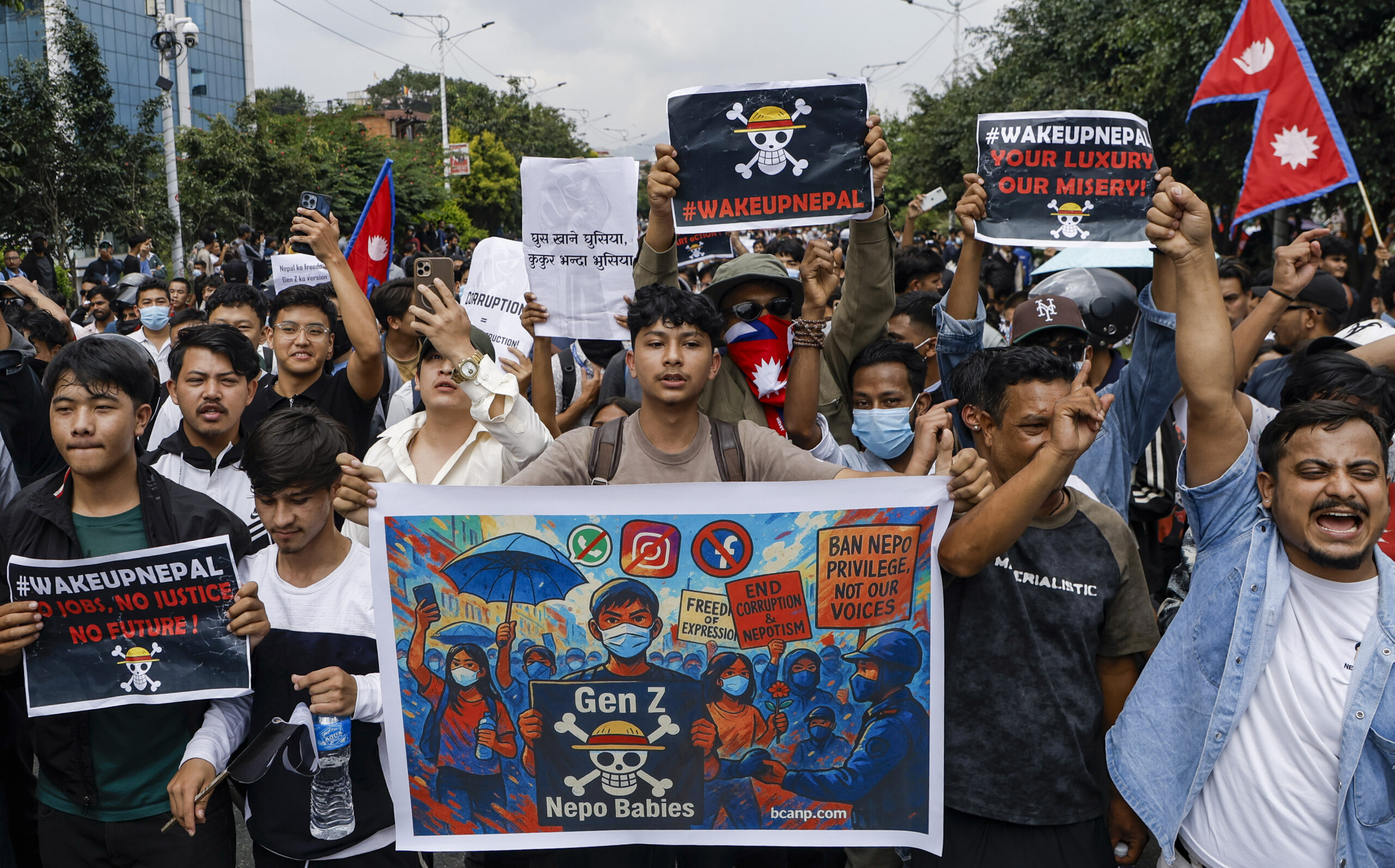
Perhaps acting preemptively in response to the events that unfolded in neighbouring countries, Nepal’s government opted to impose a far-reaching ban in September 2025 on 26 different social media platforms due to controversial regulatory requirements.[18] Nepal’s youth interpreted the ban as a means to censor dissent and restrict free speech.[19] Long-standing grievances due to persistent corruption, nepotism, and economic stagnation, including a lack of opportunities for youth, led to no administration completing a full tenure since 2008.[20] Protestors circumvented the ban using virtual private networks, through which they echoed longstanding frustrations regarding the state of governance in the country.[21] Thus, through online platforms, protestors – who were mainly students – were able to coordinate large demonstrations against Prime Minister K.P. Sharma Oli. Unfortunately, many protestors died and more were injured in the widespread clashes.[22] September 8th marked a significant day in Nepalese politics as thousands of protestors gathered for demonstrations in Kathmandu, and forces resorted to tear gas, rubber bullets, and even live fire to disperse the crowds.[23] Ultimately, Prime Minister Oli resigned, and the interim prime minister was elected through an organized vote on Discord, a prominent social media app.[24] Thereby, the struggle upended the status quo in the country, providing a fresh start and new direction for Nepal that is representative of its citizens.
Conclusion
Across Sri Lanka, Bangladesh, and Nepal, youth-led protests demonstrate Gen-Z’s emerging role in reshaping political change in the modern age. Repeatedly, protestors employ social media to organize themselves and spread awareness. However, the drivers behind these movements remain the same: economic collapse, corruption, and authoritarian regimes that aim to exploit their power at the expense of opportunities for today’s youth. These movements illustrate the power of digital literacy, and they reinforce that collectivism is necessary to hold governments accountable and ensure the best interests of the common person. Furthermore, these events signal a generational shift in political engagement, highlighting the global potential of youth to impose rapid change. The message is clear: the world’s youth have chosen to rewrite the rules of political power.
Bibliography
Al Jazeera. “Topple This Government: Nepal’s Gen Z Protesters Demand Mass Resignations.” Al Jazeera, September 9, 2025. https://aje.io/uypo6e.
Al Jazeera. “Nineteen Killed in Nepal Protests over Social Media Ban, Corruption.” Al Jazeera, September 8, 2025.
Amnesty International. “Bangladesh: What Is Happening at the Quota Reform Protests?” July 2024. Accessed December 12, 2025. https://www.amnesty.org/en/latest/news/2024/07/what-is-happening-at-the-quota-reform-protests-in-bangladesh/.
Amnesty International. “Sri Lanka: End the Crackdown on Peaceful Protests.” Accessed December 12, 2025. https://www.amnesty.org/en/petition/end-the-crackdown-on-peaceful-protests-in-sri-lanka/.
Associated Press News. “Bangladesh Faces Uncertain Transition After Mass Protests Force Prime Minister’s Exit.” August 2024. Accessed December 12, 2025. https://apnews.com/.
BBC News (via Reuters). “Young Anti‑Corruption Protesters Oust Nepal PM Oli.” Reuters, September 9, 2025.
BTI Transformation Index. Sri Lanka Country Report 2022. Gütersloh: Bertelsmann Stiftung, 2022. https://bti-project.org/en/reports/country-report/LKA.
Carnegie Endowment for International Peace. “Sri Lanka’s Aragalaya Protest Movement and Its Political Legacy.” Accessed December 12, 2025. https://carnegieendowment.org/.
Timberman, David G. “The Aragalaya Protest Movement and the Struggle for Political Change in Sri Lanka.” Carnegie Endowment for International Peace, August 27, 2025. Accessed December 20, 2025. https://carnegieendowment.org/research/2025/08/sri-lanka-aragalaya-protest-movement-oust-wickremesinghe-rajapaksa?lang=en.
Dhaka Tribune. “2024 in Review: A Turning Point in Bangladesh’s Political History.” December 2024. Accessed December 12, 2025. https://www.dhakatribune.com/bangladesh/.
Euronews. “Nepal Lifts Social Media Ban Following Deadly Protests.” September 8, 2025. https://euronews.com/.
Ethan Teekah. “2025 Nepalese Gen Z Protests.” Encyclopedia Britannica, September 9, 2025. https://www.britannica.com/event/2025-Nepalese-Gen-Z-Protests.
Human Rights Watch. “Bangladesh: Deadly Force Used Against Student Protesters.” July 2024. Accessed December 12, 2025. https://www.hrw.org/.
Human Rights Watch. “Nepal: Police Fire on ‘Gen Z’ Protest.” Human Rights Watch, September 9, 2025.
Human Rights Watch. “Sri Lanka: Revoke Sweeping New Order Restricting Protests.” September 27, 2022. https://www.hrw.org/news/2022/09/27/sri-lanka-revoke-sweeping-new-order-restrict-protest.
Institute for Conflict, Peace and Security (ICPS). “From Protest to Power: Student Mobilization and Political Change in Bangladesh.” 2024. Accessed December 12, 2025. https://www.icpsnet.org/issuebrief/from-protest-to-power-090625.
Institute for Conflict, Peace and Security (ICPS). “The Fall of Sheikh Hasina and Bangladesh’s Political Transition.” August 2024. Accessed December 12, 2025. https://www.icpsnet.org/issuebrief/Fall-of-Hasina-and-Political-Transition-in-Bangladesh.
The Guardian. “Why Are People Protesting in Sri Lanka?” April 6, 2022. https://www.theguardian.com/world/2022/apr/06/why-are-people-protesting-in-sri-lanka.
Footnotes
- Amnesty International, “Sri Lanka: End the Crackdown on Peaceful Protests,” accessed December 12, 2025, https://www.amnesty.org/en/petition/end-the-crackdown-on-peaceful-protests-in-sri-lanka/. ↑
- BTI Transformation Index, Sri Lanka Country Report 2022 (Gütersloh: Bertelsmann Stiftung, 2022), https://bti-project.org/en/reports/country-report/LKA. ↑
- Human Rights Watch, “Sri Lanka: Revoke Sweeping New Order Restricting Protests,” September 27, 2022, https://www.hrw.org/news/2022/09/27/sri-lanka-revoke-sweeping-new-order-restrict-protest. ↑
- Ibid. ↑
- Ibid. ↑
- Ibid. ↑
- Ibid ↑
- David G. Timberman, “The Aragalaya Protest Movement and the Struggle for Political Change in Sri Lanka,” Carnegie Endowment for International Peace, August 27, 2025, accessed December 20, 2025, https://carnegieendowment.org/research/2025/08/sri-lanka-aragalaya-protest-movement-oust-wickremesinghe-rajapaksa?lang=en. ↑
- Ibid. ↑
- Ibid. ↑
- Amnesty International, “Bangladesh: What Is Happening at the Quota Reform Protests?” July 2024, accessed December 12, 2025, https://www.amnesty.org/en/latest/news/2024/07/what-is-happening-at-the-quota-reform-protests-in-bangladesh/. ↑
- Dhaka Tribune, “2024 in Review: A Turning Point in Bangladesh’s Political History,” December 2024, accessed December 12, 2025, https://www.dhakatribune.com/bangladesh/. ↑
- Ibid. ↑
- Institute for Conflict, Peace and Security (ICPS), “From Protest to Power: Student Mobilization and Political Change in Bangladesh,” 2024, accessed December 12, 2025, https://www.icpsnet.org/issuebrief/from-protest-to-power-090625. ↑
- Human Rights Watch, “Bangladesh: Deadly Force Used Against Student Protesters,” July 2024, accessed December 12, 2025, https://www.hrw.org/. ↑
- Institute for Conflict, Peace and Security (ICPS), “From Protest to Power: Student Mobilization and Political Change in Bangladesh,” 2024, accessed December 12, 2025, https://www.icpsnet.org/issuebrief/from-protest-to-power-090625. ↑
- Institute for Conflict, Peace and Security (ICPS), “The Fall of Sheikh Hasina and Bangladesh’s Political Transition,” August 2024, accessed December 12, 2025, https://www.icpsnet.org/issuebrief/Fall-of-Hasina-and-Political-Transition-in-Bangladesh. ↑
- Al Jazeera, “Topple This Government: Nepal’s Gen Z Protesters Demand Mass Resignations,” September 9, 2025, https://aje.io/uypo6e. ↑
- Ethan Teekah, “2025 Nepalese Gen Z Protests,” Encyclopedia Britannica, September 9, 2025, https://www.britannica.com/event/2025-Nepalese-Gen-Z-Protests. ↑
- Ibid. ↑
- BBC News (via Reuters), “Young Anti‑Corruption Protesters Oust Nepal PM Oli,” September 9, 2025. ↑
- Al Jazeera, “Nineteen Killed in Nepal Protests over Social Media Ban, Corruption,” September 8, 2025. ↑
- Human Rights Watch, “Nepal: Police Fire on ‘Gen Z’ Protest,” September 9, 2025. ↑
- Euronews, “Nepal Lifts Social Media Ban Following Deadly Protests,” September 8, 2025, https://euronews.com/. ↑