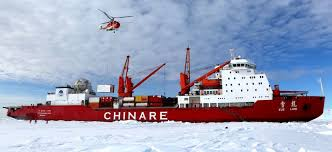
As China continues to steer clear of U.S. operations, shipping routes have become a point of contention. With global warming significantly reducing the amount of ice present in Arctic waters, there is an emerging significance to exploring Arctic shipping routes (Company Launches China-Europe Shipping Route, 2025). Expanding Chinese influence in arctic shipping falls in line with China’s strategic interest in developing these routes under ambitions for the Ice Silk Road outlined in the BRI (Belt and Road Initiative).
Setting sail on September 22nd from Ningbo, China, the ship called the Istanbul Bridge reached Britain 18 days later on October 10th (The Maritime Executive, 2025). This is a 50% reduction in shipping time compared to the current Suez Canal route. Faster shipping routes would ease pressure on the ever-growing trade market between Europe and China. In the first 7 months of this year, trade between China and Europe reached 465.3 billion dollars (Zhang, 2025). With faster shipping, an estimated 40% of inventory holding in China could be cut for electronics, releasing capital tied up in supply chains (Zhang, 2025). While the route is set to run weekly during the summer months, the operating company is hopeful to expand its construction of container fleets that are capable of navigating ice in order to make the route year-round (The Maritime Executive, 2025). Currently, many say this would not be the optimal shipping route due to high costs. But when modelling with a 10-20% reduction in fees, which can reasonably be achieved as more ships sail the route and navigation costs decrease, we see that the NSR (Northern Sea Route) becomes the optimal route for roughly ⅓ of China products. (Fig. 1, Zhou et al. pg 14). For now, the company will be combining the Suez routes with rail links during the harsher winter months for a quick 25-day shipping period (Zhou et al. pg 5). But using Fig. 2, we can see there is a scenario where the Suez Canal and other shipping routes are bypassed completely (Zhou et al. pg 7), shifting solely to the infrastructure developed by the BRI, including the 3 main shipping corridors and the NSR.
If these strategies were to succeed, the US would face losses in global trade leverage, tech competition in polar navigation, and a blow to the US naval posture. Since 1946, the United States has sent Egypt 85 billion dollars and is currently sending roughly 1.3 billion dollars per year (Jahic, 2024). Aiming to strengthen regional security and the Egyptian military, the US gains access to the Suez Canal for shipping and military operations(Jahic, 2024). Losing Chinese reliance on the Suez Canal would leave the US without a key leverage point. China relies on the Suez Canal to receive Russian oil imports and to send 60% of all trade with Europe (Citadel, 2024). As it stands, the US and other G7 countries could use the Suez Canal as leverage to impose sanctions on China in the event of potential conflicts (Citadel, 2024). Therefore, Chinese operations are forced to use a detour which would add 10-15 days (Citadel, 2024). Expanding the NSR would allow China to become significantly less reliant on the Western-controlled routes and send more through routes they have funded.
If successful, this will allow China to increase their geopolitical advantage and achieve the Chinese Communist Party’s sought-after expansion for the Ice Silk Road. It will also feed into ties with Russia, as Putin has continuously expressed interest in companies expanding shipping routes in the Arctic (Funaiole, 2023). China’s use of the NSR is a sign of a shift in Russia’s global strategy. Historically, the Arctic has been one of Russia’s most guarded assets, with the Russian military conducting some of its most sensitive operations along that route, such as missile defence systems, advanced radar, and ballistic missile submarines (Funaiole, 2023). In 2012, Russia blocked Chinese research vessels from completing research along the NSR (Funaiole, 2023). But that dynamic now seems to be changing.
Since the beginning of the war in Ukraine, Russia has been increasingly shunned by the rest of the world and thus increasingly more reliant on China for resources and investments (Funaiole, 2023). In 2019, a study to identify ports in Russian that had the greatest strategic interest for facilitating Chinese operations in the region (Funaiole, 2023), while major Chinese firms have already begun pouring money into some of the key ports listed. The 300 million Chinese investment was already spent on a coal terminal in Murmansk, a deep-water port being developed in Arkhangelsk, and funding 60% of Russia’s liquefied natural gas project in Sabetta (Funaiole, 2023). All these investments further cement Sino-Russian relations as well as China’s need for this project to succeed.
China’s expanding use of Arctic shipping routes signals a potential reordering of global maritime power as melting ice makes the Arctic increasingly more navigable. China’s Ice Silk Road ambitions under the BRI promise faster transit times, reduced inventory costs, and great efficiency for Sino-European trade. While the NSR is not yet a full substitute for traditional routes, modelling suggests that with declining fees and improved infrastructure, the NSR could become a viable option for a significant share of Chinese trade. For the US, this shift carries clear strategic consequences. Reduced Chinese reliance on the Suez Canal would weaken a key source of US leverage over global shipping sanctions, in the meantime, diminishing American influence over critical maritime chokepoints. At the same time, China’s continued cooperation with Russia in Arctic infrastructure reflects their growing dependence on each other. All together, the issue of Arctic shipping intersects climate change, economic strategy, and great power competition. And if China is able to succeed in their Arctic ambitions, the rest of the world will need to change its maritime strategies accordingly.
Appendix


Elizabeth Coffin-MacDougall is a Contributor for the Synergy Journal’s East Asian section and a second year student studying Political Science and Contemporary Asian Studies at the University of Toronto. Her research interests are current world events, particularly economics.
Bibliography
Citadel. “China’s Dependence on Suez Canal Presents Vulnerability.” Citadel, 2024, centcomcitadel.com/en_GB/articles/ssc/features/2024/06/15/feature-01. Accessed 15 Dec. 2025.
Funaiole, Matthew P. “Frozen Frontiers: China’s Great Power Ambitions in the Polar Regions.” CSIS, 18 Apr. 2023, features.csis.org/hiddenreach/china-polar-research-facility/
Jahic, Naida. “Foreign Aid to Egypt: Balancing Stability and Reform – the Borgen Project.” The Borgen Project, 11 Dec. 2024, borgenproject.org/foreign-aid-to-egypt/.
Reuters Staff. “Company Launches China-Europe Shipping Route, Global Times Says.” Reuters, 22 Sept. 2025, www.reuters.com/sustainability/climate-energy/company-launches-china-europe-shipping-route-global-times-says-2025-09-22/.
“Security Council Adopts Resolution 2768 (2025), Sustaining Monthly Reporting on Houthi Attacks in Red Sea | UN Meetings Coverage and Press Releases.” Un.org, 15 Jan. 2025, press.un.org/en/2025/sc15965.doc.htm?_gl=1. Accessed 15 Dec. 2025.
The Maritime Executive. “Sea Legend’s New China-Europe Arctic Shipping Service Draws Scrutiny.” The Maritime Executive, 25 Sept. 2025, maritime-executive.com/article/sea-legend-s-new-china-europe-arctic-shipping-service-draws-scrutiny . Accessed 15 Dec. 2025.
Zhang, Weilan. “China-Europe Arctic Route to Enter Regular Summer Operation in 2026 – Global Times.” Globaltimes, 2025, www.globaltimes.cn/page/202510/1346110.shtml. Accessed 15 Dec. 2025.
Zhou, Yutao, et al. “Exploring the Dynamic Impact of the Northern Sea Route on China-Europe Multimodal Transportation Competition in the Context of the Belt and Road Initiative.” Ocean & Coastal Management, vol. 257, 27 Aug. 2024, www.sciencedirect.com/science/article/pii/S0964569124003314?pes=vor&utm_source=scopus&getft_integrator=scopus, https://doi.org/10.1016/j.ocecoaman.2024.107346. Accessed 19 Oct. 2025.