Mohandas Karamchand Gandhi, also known as Mahatma Gandhi, is “often called the ‘father of India’ and a ‘great soul in beggar’s garb.’”[1] His anti-colonial efforts yielded India’s independence as his interpretation of swaraj, i.e. self-rule – a concept that had underpinned South Asian politics throughout the 20th century, entailed complete independence from British rule and institutions. This interpretation marked a profound departure from the political objectives of earlier Indian National Congress (INC) leaders like Dadabhai Naoroji and Bal Gangadhar Tilak, who called for increased Indian involvement in government and economic self-reliance, while maintaining loyalty to Britain. Further, Gandhi’s leadership fundamentally transformed India’s freedom struggle as he founded mass movements using a non-violent approach named satyagraha.
Dadabhai Naoroji, the INC’s first President, appreciated British rule, yet laid the foundations for economic self-rule as he called for increased Indian involvement in government as a means to end British economic exploitation of India.[2] Unlike Naoroji, Gandhi believed it was impossible for the British economic exploitation of India to halt, for just as a tiger cannot change its nature, neither can the British.[3] Like Naoroji, Tilak, who first introduced the political concept of swaraj and deemed that self-rule was his birthright, encouraged economic self-reliance.[4] He promoted the patronage of swadeshi – locally-made – goods.[5] However, his supporters, while desiring an Indian government, wished to keep British military, political, and economic institutions.[6] While Naoroji and Tilak advocated for India to be given self-governance similar to that of South Africa and Canada, Gandhi rejected this understanding of swaraj, deeming it “a suicidal policy.”[7] He instead reasoned that, like Japan, India must be completely autonomous and have its “own navy…army and… splendour.”[8] Gandhi’s lack of loyalty to Britain marked a key transformation in the INC’s goals. This transition was informed by the fact that Gandhi’s rise took place following the Jallianwala Bagh massacre, a notable symbol of colonial injustice, in which a British general fired against peaceful protesters, killing 370 and wounding over 1,000.[9] Against this backdrop, Gandhi stated, “I can no longer retain affection for a Government so evilly manned as it is nowadays.”[10] In this vein, Gandhi opposed what the British deemed civilized, arguing that industrialization did not civilize society; it merely made men’s condition “worse than that of beasts.”[11] Gandhi explained that due to British ‘civilization’, Indians transitioned from being enslaved by physical compulsion to being enslaved by “the temptation of money and…luxuries” it can buy.[12] He believed that Indians gave away their country to the British, implying that to achieve swaraj, Indians must take it back.[13]
Gandhi’s vision of swaraj caused a fundamental reshaping of the national movement’s nature, as he introduced mass movements, becoming the first mass leader. As Shahid Amin reveals, many groups felt a sense of devotion to Gandhi, associating him with God.[14] A key element of garnering such mass support was that his appeal was not uniform across India; instead, various groups “made of him the ‘mahatma’ they wanted.”[15] Gandhi appealed across faiths, attempting to bridge religious divides between Hindus and Muslims. Notably, in opposing British civilization, he argued Islam would consider it “a Satanic civilisation [while] Hinduism calls it the Black Age.”[16] Further, in deeming India irreligious, Gandhi does not implicate a singular religion; rather, he critiques that, irrespective of religious affiliation, India is turning away from God.[17] Unlike Tilak, who launched Hindu revivalism and the Cow Protection Movement, Gandhi supported the creation of a unified India, where people of differing faiths are united under one nationality.[18] Gandhi asserts, “The Hindus, the Mahomedans, the Parsees and the Christians who have made India their country are fellow countrymen.”[19] Further, he opposes the Cow Protection Movement, asserting that while he respects the cow and would give his life for her, he would not take the life of his Muslim countryman to save the cow.[20] In this vein, Gandhi opposes the visions of Hindutva thinkers, such as Savarkar and Golwalkar, and INC leaders Malaviya and Mukherjee, as he rejects the notion that “India should be peopled only by Hindus.”[21]
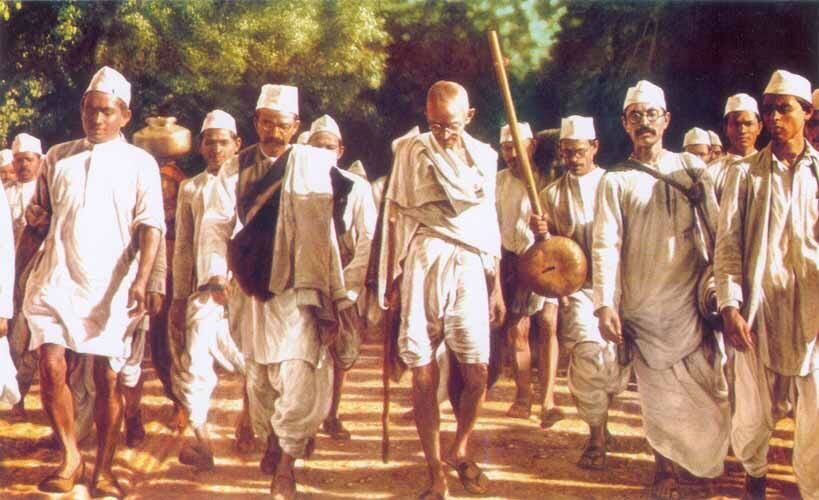
Gandhi’s vision of a diverse, unified India was reflected in his use of mass politics as he appealed to a variety of groups, ultimately using mass politics to radically change the trajectory of India’s freedom struggle. Gandhi’s mastery of mass protest was evident in the Non-Cooperation, Civil Disobedience, and Quit India movements. He rejected British protests’ violent tactics, such as those employed in the suffragette movement; accordingly, he deployed non-violence as his strategy, naming it satyagraha, i.e.“truth force or soul force.”[22] Satyagraha encompassed sit-ins, peaceful raids, and boycotts of laws and institutions.[23] Gandhi’s approach not only mobilized the masses, but it also transformed the perception of mass protest from “unruly and dangerous” to “disciplined, purposeful disruption”[24] Further, Gandhi’s organization of the 1920 Non-Cooperation movement highlighted his ability to appeal to various groups and thereby rally the masses. In organizing Non-Cooperation, Gandhi appealed to the Ottoman khilafat’s Muslim supporters, using their votes to gain a majority and secure Congress approval for his movement.[25] The move marked a significant change in the INC’s approach, because instead of pursuing self-rule through constitutional means, it used peaceful extra-constitutional mass struggle by boycotting government schools, courts, Legislative Councils, foreign cloth, and government titles. While the peaceful Non-Cooperation movement ultimately failed as violence broke out in the Chauri Chaura incident, Gandhi continued his efforts to attain swaraj non-violently, notably through the 1930 Civil Disobedience movement, in which he opposed the Salt Tax.[26] Salt resonated with all Indians and thus was a symbol that allowed Gandhi to generate mass support.[27] Further, this movement’s unprecedented female participation stressed how Gandhi appealed to formerly underrepresented groups.[28] Finally, Gandhi’s command over the masses was exhibited through the eventually quashed yet iconic Quit India movement, a mass protest by various groups such as students, factory workers, local low-level leaders, and peasants; this protest stemmed from opposition to Britain’s unilateral declaration of Indian participation in World War 2.[29] Gandhi inspired this movement despite being imprisoned, as his “Do or Die” speech – in which he asserted “violence was preferable to cowardice” by likening India to “a young woman attacked by a soldier… [who] ought to fight back with teeth and nails rather than submit to rape” – was foundational for the movement.[30]
On balance, Gandhian politics transformed the INC’s objective from gaining constitutional self-governance to eliminating British rule, and Gandhi’s reliance on mass politics reflected a fundamental reshaping of the national freedom struggle.
Bibliography
Blakemore, Erin. “How Mahatma Gandhi Changed Political Protest.” National Geographic. National Geographic, September 27, 2019. https://www.nationalgeographic.com/culture/article/mahatma-gandhi-changed-political-protest.
Amin, Shahid. 1988. ‘Gandhi as Mahatma’. In Selected Subaltern Studies, edited by Ranajit Guha and Gayatri Chakravorty Spivak, 288–350. United States of America: Oxford University Press.
Gandhi, M.K. (1997) 2009. Gandhi: “Hind Swaraj” and Other Writings. Edited by Anthony Parel. Cambridge University Press.
Bose, Sugata, and Ayesha Jalal. 2004. Modern South Asia: History, Culture, Political Economy. Florence: Taylor & Francis Group. Accessed April 10, 2025. ProQuest Ebook Central.
Laxman, Shibi. “Radical Nationalism and the Swadeshi Movement.” HIS282Y1: History of South Asia. Class lecture at University of Toronto, Toronto, ON, January 23, 2025.
Laxman, Shibi. “Post-War Reforms and Gandhian Era – Towards Mass Politics.” HIS282Y1: History of South Asia. Class lecture at University of Toronto, Toronto, ON, February 11, 2025.
Laxman, Shibi. “Gandhi: Khilafat Movement and Mass Politics.” HIS282Y1: History of South Asia. Class lecture at University of Toronto, Toronto, ON, February 13, 2025.
Laxman, Shibi. “Hindu Communalism and Demand of Pakistan” HIS282Y1: History of South Asia. Class lecture at University of Toronto, Toronto, ON, March 4, 2025.
McDermott, Rachel Fell, Leonard A Gordon, Ainslie Thomas Embree, Dennis Dalton, and Frances W Pritchett, eds. 2014. “Chapter 4. Liberal Social and Political Thought in the Late Nineteenth and Early Twentieth Century.” In Sources of Indian Traditions, 187–94. New York: Columbia University Press.
Metcalf, Barbara D, and Thomas R Metcalf. 2006. A Concise History of Modern India, 2nd ed. Cambridge: Cambridge University Press.
- Erin Blakemore, “How Mahatma Gandhi Changed Political Protest,” National Geographic (National Geographic, September 27, 2019), www.nationalgeographic.com/culture/article/mahatma-gandhi-changed-political-protest. ↑
- Rachel Fell McDermott et al., eds., “Chapter 4. Liberal Social and Political Thought in the Late Nineteenth and Early Twentieth Century,” in Sources of Indian Traditions (New York: Columbia University Press, 2014), 190-191; Sugata Bose and Ayesha Jalal, Modern South Asia: History, Culture, Political Economy, 2nd ed. (New York: Routledge, 2004), 81. ↑
- M.K. Gandhi, Gandhi: “Hind Swaraj” and Other Writings, ed. Anthony Parel (1997; repr., Cambridge University Press, 2009), 27. ↑
- Shibi Laxman. “Radical Nationalism and the Swadeshi Movement.” HIS282Y1: History of South Asia (class lecture at University of Toronto, Toronto, ON, January 23, 2025); Barbara D Metcalf and Thomas R Metcalf, A Concise History of Modern India, 2nd ed. (Cambridge: Cambridge University Press, 2006), 150. ↑
- Metcalf and Metcalf, A Concise History of Modern India, 152. ↑
- Gandhi,“Hind Swaraj” and Other Writings, xv, 27; Shibi Laxman. “Post-War Reforms and Gandhian Era – Towards Mass Politics” HIS282Y1: History of South Asia (class lecture at University of Toronto, Toronto, ON, February 11, 2025). ↑
- Gandhi,“Hind Swaraj” and Other Writings, 27. ↑
- Gandhi,“Hind Swaraj” and Other Writings, 27-28. ↑
- Metcalf and Metcalf, A Concise History of Modern India, 168. ↑
- Metcalf and Metcalf, A Concise History of Modern India, 169. ↑
- Gandhi,“Hind Swaraj” and Other Writings, 36. ↑
- Gandhi,“Hind Swaraj” and Other Writings, 39. ↑
- Gandhi,“Hind Swaraj” and Other Writings, 39. ↑
- Shahid Amin, “Gandhi as Mahatma,” In Selected Subaltern Studies, edited by Ranajit Guha and Gayatri Chakravorty Spivak, (New York: Oxford University Press, 1988), 292, 311. ↑
- Metcalf and Metcalf, A Concise History of Modern India, 175. ↑
- Gandhi,“Hind Swaraj” and Other Writings, 37. ↑
- Gandhi,“Hind Swaraj” and Other Writings, 42. ↑
- Metcalf and Metcalf, A Concise History of Modern India, 152-153; Gandhi,“Hind Swaraj” and Other Writings, 52. ↑
- Gandhi,“Hind Swaraj” and Other Writings, 52. ↑
- Gandhi,“Hind Swaraj” and Other Writings, 53. ↑
- Shibi Laxman. “Hindu Communalism and Demand of Pakistan” HIS282Y1: History of South Asia (class lecture at University of Toronto, Toronto, ON, March 4, 2025); Gandhi,“Hind Swaraj” and Other Writings, 53. ↑
- Gandhi,“Hind Swaraj” and Other Writings, xv, 37; Shibi Laxman. “Post-War Reforms and Gandhian Era – Towards Mass Politics.” ↑
- Shibi Laxman, “Post-War Reforms and Gandhian Era – Towards Mass Politics.” ↑
- Shibi Laxman, “Post-War Reforms and Gandhian Era – Towards Mass Politics.” ↑
- Metcalf and Metcalf, A Concise History of Modern India, 175. ↑
- Shibi Laxman. “Gandhi: Khilafat Movement and Mass Politics.” HIS282Y1: History of South Asia (class lecture at University of Toronto, Toronto, ON, February 13, 2025). ↑
- Shibi Laxman. “Gandhi: Khilafat Movement and Mass Politics.” ↑
- Shibi Laxman. “Gandhi: Khilafat Movement and Mass Politics.” ↑
- Metcalf and Metcalf, A Concise History of Modern India, 206. ↑
- Metcalf and Metcalf, A Concise History of Modern India, 206; Bose and Jalal, Modern South Asia, 131. ↑